Workflow: Blogging

While participating in #satchat last Saturday, Dr. Reshan Richards offered a concise master class in the how and why of blogging.  I embedded his tweets below with some brief contextualizations / explanations.


By establishing rules for himself — “format and schedule” — Reshan re-launched his blogging practice.

Focus allows side projects, like blogging, to feel manageable and not chew up too much time.

What gets scheduled gets done.

Constraints allow side projects to fit into crowded calendars.

As we learn in the gym or on the track, reps add up.  And, in creative practice, one of the key, though counterintuitive, insights is that habitual (i.e. predictable / boring) practice allows creative practice to thrive.

This is the point Twyla Tharp makes in The Creative Habit . . . and Austin Kleon drives home in an evergreen blog post called “Something Small Everyday.”   (See his related blackout poem below.)

something-small-daily-cropped-500x766

Beyond habits, Reshan is big on internal motivation.  As I heard him recently say in an as-yet-unpublished interview, “any activities done as part of a learning experience should be done with intrinsic motivation. Human beings of course need boundaries and rules to feel safe, but they should also be given flexibility and understanding when a task is not complete.”  It didn’t surprise me, therefore, when he said:

Also, it didn’t surprise me when he said:

You get ideas by capturing them. When I was young, I marveled at the artists and writers I met.  They always seemed to have so many more ideas than everybody else.  A simple drive to a bagel store could yield five new poems, six new photographs, three new essay ideas, nine new short film projects . . .

Now that I’m older and have several hundred thousand words under my own belt, I know that everyone has ideas.  But people who traffic in ideas, people who need to generate lots of them, are simply more disciplined about capturing their ideas. They have more ideas because they keep more ideas.

Last, though certainly not least, is gratitude.

Check out Reshan’s payback / payforward at www.constructivisttoolkit.com.  It’s a wonderful assortment of fresh ideas, new every weekday.  Leave him a comment somewhere and let him know what you think.
Closing Up Shop: 12/4/15

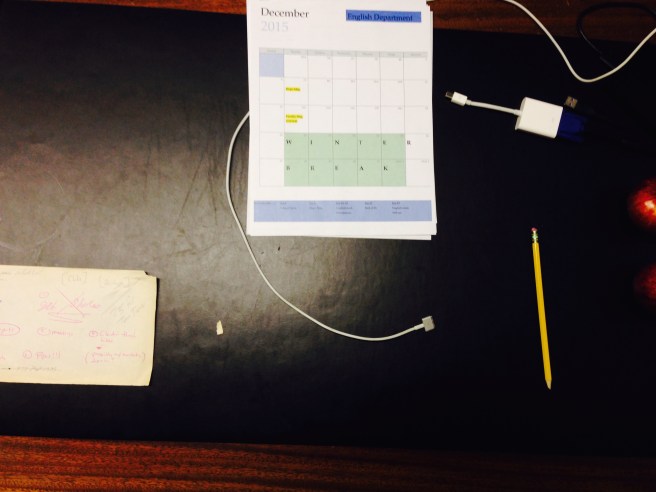
Each Friday before heading home, I straighten up my desk (only so much) and think back over the week.  In this time/space, I’m looking for one thing the week really taught me, one thing I don’t want to forget.

Here’s a picture of my desk, as left on 12/4/15:

FullSizeRender

And here’s the insight I want to remember from the week of 11/30/15:

If you want to help students learn, you have to find a way to see their thinking about, and their struggles with, an assignment BEFORE you grade the assignment.  

Share your own insight in the comments.

Workflow: Email as Index

Here’s a workflow I’ve been using this year to make my inbox even more productive.

Some emails don’t require immediate action and yet you know you will need to reference them at a later date.

Instead of pulling data out of these emails, reformatting them in a different application, or putting them in a  folder, try this:

Open the email message.

Screen Shot 2015-12-04 at 11.59.49 AM.png

Then, forward the message to yourself, giving it a new subject line to help you retrieve it, via search, when you need it.

Screen Shot 2015-12-04 at 12.02.10 PM.png

Then, and this is the crucial step, log the category (in this case, Student Conference) in a place you can find it.  I use a TextEdit file, stored on my desktop, to keep track of any new category I add.  For some reason, this process works for me.  When an event occurs (like Clubs or a Student Conference, or a Reimbursement) and I have created a category for it, I generally remember to run a quick search, see every “tagged” email related to it, and then retrieve the right email at the precise moment I need it.

I’m sure there are better, more sophisticated ways to generate the same result — but this one works for me.


Obligatory note of caution: If you’re going to make use of this workflow, please remember the wise words of Dr. Reshan Richards:

Automation and efficiency are worthy goals, but once you have achieved one or the o

For more texts and tidbits on technology, subscribe to my infrequent newsletter.

Leadership and Slowness

If you aspire to lead schools, whether as a Dean or a Division Head, do yourself a favor, do your school a favor, and slow down.

Too many emerging school leaders seem to be in a rush to “climb the ladder.”  They want the next job. Or the job after the next job. (Yes, this even happens in organizations like schools where careerism is often seen as a dirty little secret.)

Move through your jobs too quickly and you lose the daily, fundamental lessons that will make you an exceptional leader rather than just a person who “got the job.”

In conversations with a few Heads of School, I have found that their paths to the “top” have been varied. Some of them have come up through the system as disciplinarians; others have a more academic or curricular background. But each and every one of them can talk, in almost mind-numbing detail, about a few big projects that they worked on or led along the way.

The “mind-numbing” part is important.  You can only talk about a project in “mind-numbing” detail when you have worked through it from every angle, when you have chewed through it and truly inhabited the work.Take, for instance, a Headmaster who worked to transform a dress code while working as a Dean of Students.  She would have met with everyone from the parents’ association to the sophomore girls who were most vocal about the change.  She would have made presentations to rooms that vilified her and rooms that cheered her.  She would have assembled and run committees.  She would have writtten the language in the dress code, revised the language, added a comma, removed a comma. . . . She would have developed elaborate metaphors to help the student body understand the importance of the dress code. And, as she completed these tasks, she would have learned about how schools function. She would have learned about compromise, about how to temper idealism with pragmatism, about the delicate dance of people that makes a school a school.

To fully understand what I mean when I talk about slowness as a prelude to leadership, think about each job at school — whether it’s a stint as a coach or a chaperoning gig on a class trip — as its own leadership novella.

The people committed to becoming the best leaders they can be take their time with each page.  They puzzle over the things that happen or fail to happen.  They follow character arcs and themes and red herrings and conflicts.   They read and reread and read again key passages in the work.  They gain a feeling for which sentences are workhorses for the plot, which sentences allude to other stories, which sentences help the narrator stall, and which sentences are just damned beautiful.  And they enjoy the process; they enjoy the science and art of close reading.

I worked at J.R. Cigars when I was younger, and I had the good fortune of spending some time with J.R. himself, a man who experienced tremendous successes in the business world, especially when the cigar trade was booming.  In some circles, he was, and still is, a legend; for me, he was the man who signed my checks as I tried to make some money before heading off to college.I came upon him once in the back of the store building.  I was throwing out some trash and he was hammering together cigar boxes that had fallen apart, a small stogie lodged in the corner of his mouth.

When I asked him why he was hammering the boxes together, he said, “I can sell em . . . or put cigars in em . . . and plus I just like the work.  It reminds me of when I was an up-and-comer.”

Up-and-comers, please slow down.  When you’re in charge, when you’re running a school and making crucial decisions about budgets and faculties and students, you’re going to want to know how to hammer together the cigar boxes.  You’re going to want to know the story of school, line by line and, as they say, by heart.

For more texts and tidbits on leadership, subscribe to my infrequent newsletter.