Asynchronous Snow Day

Here in New Jersey, we have a snow day, and a colleague mentioned to me that she might try to “run an asynchronous meeting” rather than rescheduling a meeting that was scheduled for today.  I shared with her this example of an email that framed a successful asynchronous meeting for my Department Chair team:

Screen Shot 2017-02-09 at 9.12.36 AM.png

Bug Business

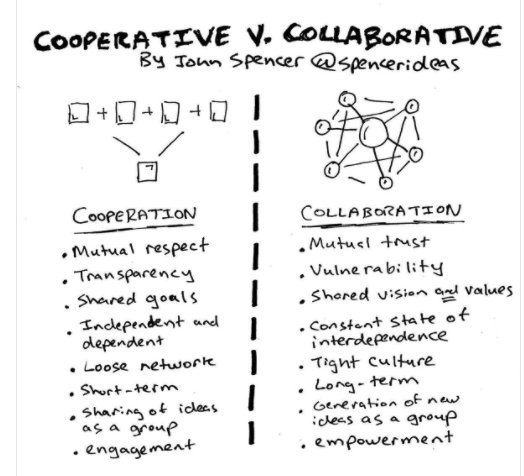
We wrote about “bug bounties” in Blending Leadership, identifying ways in which the approach and mindset that drives such work could be useful to schools.  Here’s a story from Venture Beat about a company that is working to organize such efforts (and raising plenty of money in the process): HackerOne, a vulnerability identification platform that helps connect security-conscious businesses with bug hunters, has raised $40 million in a Series C round led by Dragoneer Investment Group.” This offers clear evidence, too, that organizing platforms around the right kinds of collaborative work is a good business model.

Permission to Drift

Here’s Jim Jarmusch talking about the Paterson character from his film Paterson.  He makes a great point about the importance of routines for creativity (and one of the reasons that I park in the exact same spot every time I go to the grocery store).

[Paterson] likes routine, because routine allows him to drift. Because he doesn’t have to think about what clothes does he wear each day, what time does he go to work, what is the route of his bus. Even walking the dog . . . is part of his routine. Everything is laid out for him, and that lets him be a poet, because within that routine, he can observe, he can be an antenna, he can drift, he can listen to people, he can write his poems by the waterfall. He needs that.

The rest of the interview is beautiful, as well, especially when Jarmusch speaks (lovingly) of his many collaborators. Thanks to Austin Kleon for sharing.

Time Zones

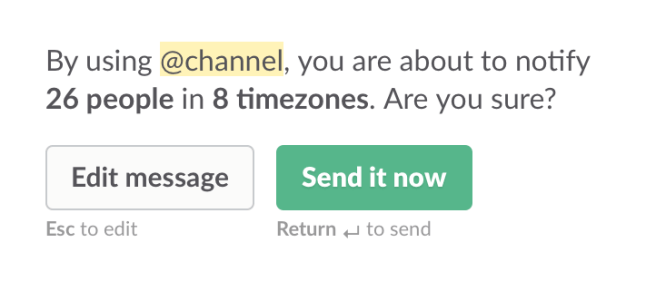
I  just sent one final message to the Global Online Academy class I ran with Reshan Richards.  The message I received from Slack before it sent the message speaks volumes about the kind of educational experience this was for me (and for the participants).

screen-shot-2017-02-02-at-11-47-59-am

Email Systems

In my writing, speaking, and (lately) conversations, I frequently refer to the idea of having a personal system to manage email.  I tell people that it doesn’t matter what system you are using, as long as you review it systematically and ensure that it’s really serving your needs.

Here’s an example of a highly detailed system that Tony Hsieh, CEO of Zappos, designed and uses: http://www.yesterbox.com.  You might not agree with it, but it’s a good starting point as you try to figure out what will work for you.

Blues for the Explorer

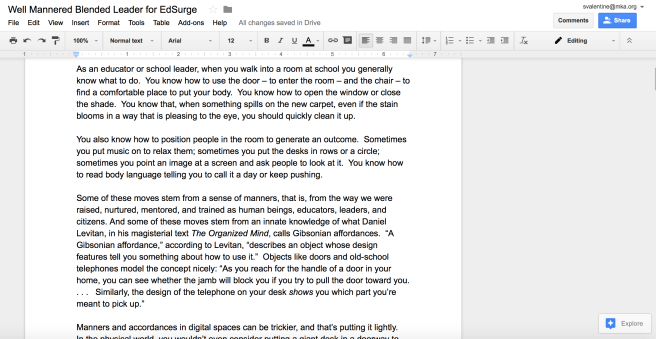
Recently I was putting the finishing touches on a column for Ed Surge (the one I’ve been writing with Reshan Richards), and my daughter looked over my shoulder and asked, “what does that button do?”

She was pointing to the bottom right corner of my the Google Doc window in which I was composing my text: the word “Explore” had caught her attention.
screen-shot-2017-01-29-at-1-34-33-pm

We clicked it together, and this happened:

screen-shot-2017-01-29-at-1-37-58-pmMy first thought was, “that’s amazing, Google can read what I’ve written, understand it a little bit, and make suggestions about how I might add depth to it by looking at related research.

My second thought was, “that’s horrifying, Google can read what I’ve written, understand it a little bit, and make suggestions about how I might add depth to it by looking at related research.”

My first thought came from marveling at the ways that Google is evolving as a company, and how it is trying to partner with me as a writer, researcher, and thinker.

My second thought came from realizing that, if I rely on Google to make connections for me, it will replace an important part of what I have to offer the world — the connections that I make, based on everything I’ve ever read, written, or seen, along with the serendipity and luck that fuels my writing process.  Indeed, I feel a little bit threatened.  Writing has existed at the core of my identify since I was in 4th grade.  If a machine can make connections that are more interesting, probing, or deft than the ones that I can make, then I will have to find something else to do — and someone else to be.

Blogging Everyday, Everyday Blogging

Seth Godin writes a blog post everyday.

Fred Wilson does the same, only different.

Reshan Richards picked up the habit, too, and I’m trying it on at the moment.

As a reader, I really appreciate writers who try to share something each day.  I don’t expect these offerings to always be great, just like I don’t expect long dinners to be great for the entire duration of the meal.  You expect lulls, come to appreciate them as runways to greatness, in fact.  And a great bite (sentence) here, a great bite (sentence) there can make the whole thing memorable and worthwhile.

As writer, I’m enjoying the daily challenge of looking back over my day and asking myself a series of questions that seem, at the very least, healthy:

What did I learn today?

Where did I stumble upon joy?

What can I share that might be useful to even a single person?  

I’m finding that the simple act of asking these questions leads me to notice more of the good parts of my life.  I predict some lulls, but thanks for showing up.

Manage Yourself / Your Calendar

I usually learn a lot when I consume anything that comes from the desk of David Sparks. Two sentences from his recent newsletter have really helped me to manage my calendar.  The key move, it seems, is an old one: you can improve your management of your calendar (or to-do list / task list / project list) by improving your management of yourself.

The trick to all of this is being honest with yourself. If you set these appointments with yourself to manage big projects but don’t keep them, you lose faith in your system and the wheels start falling off (https://www.macsparky.com/blog/2016/12/tasks-vs-calendar-events).

What this means for me is that, assuming I’m not interrupted by something urgent, I’m trying to be meticulous about completing items that I put in my calendar, even if I don’t feel like doing them.  So, today, I scheduled an hour to write and email a recommendation letter.  It’s not due until February 15, so I could have brushed off the reminder when it appeared.  But I completed the task (in 5o minutes) and now I don’t have to think about it again.  My system gets stronger, according to the inversion of Sparks’ logic, when I stick to it.

Then, as a bonus, I used the extra 10 minutes in my schedule to take a walk around the building.  This move was prompted by the advice of my friend Reshan Richards, which he shared  with our Global Online Academy class via Slack recently:

screen-shot-2017-01-25-at-4-27-13-pm