Blending Leadership in the Wild

I recently returned to an article from The New York Times Magazine.  It’s about Terry Tao, a mathematician, and I love the description of Tao’s working methods.

Key words: bridge-builder, collaborator, celebrates the work of others, shares, documents, delights in corrections, comments, cooperative, network, connecting.

Tao has emerged as one of the field’s great bridge-­builders. At the time of his Fields Medal, he had already made discoveries with more than 30 different collaborators. Since then, he has also become a prolific math blogger with a decidedly non-­Gaussian ebullience: He celebrates the work of others, shares favorite tricks, documents his progress and delights at any corrections that follow in the comments. He has organized cooperative online efforts to work on problems. ‘‘Terry is what a great 21st-­century mathematician looks like,’’ Jordan Ellenberg, a mathematician at the University of Wisconsin, Madison, who has collaborated with Tao, told me. He is ‘‘part of a network, always communicating, always connecting what he is doing with what other people are doing.’’

Blending Leadership in the Wild

Some people assume that, when Reshan Richards and I talk or write about blending leadership, we’re pushing people to use technology more frequently.  To set the record straight, we favor technology only when it helps leaders do their jobs in ways that are more human and more joyful.  Even efficiency, which can cut out the human all together, should be done with the intention of opening up space and time for richer interactions and more meaningful work.

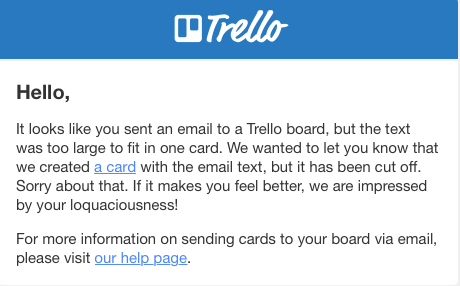
Here’s a nice example that happens to be a technological example.  Recently, I sent an email to one of my Trello boards.  Almost immediately, I received an email in return:

Screen Shot 2016-04-15 at 1.28.38 PM.png
I figure this email came from some kind of Trello bot, not a real person — and was triggered automatically. But . . . whoever programmed the exchange demonstrated sound blended leadership.  First, he or she solved a reoccurring problem once, and then figured out a way to automate the response.  My hope is that this freed up time for Trello to make its great product even better.  Second, he or she took the time to interject some personality  — “we are impressed by your loquaciousness” — into an otherwise mechanical exchange.   Third, and finally, the link in the second paragraph empowers me, as the user, to fix my mistake if it really bothers me.

This is a small (and fine) example of blended leadership in the wild.  My book on the subject (coauthored with Reshan) isn’t out until July, but I’ll keep collecting examples as I encounter them in my daily work and life.

Launching a Committee

Today I attended the first meeting of a new committee.  I have been on dozens of committees, but the leader of this particular committee started his committee in a way that demonstrated outstanding leadership.  He said three things that I have paraphrased below.

  1. I called this committee to explore _____.  The issue is not urgent at the moment, and that’s why we’re doing this work now.  We shouldn’t only examine issues like this one after — or in the midst of — a crisis.
  2. I called this committee because I want us to start with a blank slate and rebuild _____ around our current school culture.
  3. I called this committee because I want to ensure that decisions surrounding _____ are not left to one person only.  These issues are too important to be left to one decision maker.

Statement 1 ensures that our work will be important, not urgent; statement 2 ensures that our work will be pragmatic and prone to succeed during the implementation stage; statement 3 is just good discipline and indicative of a humble leader who believes in the people he leads.

A Cheap Guitar from Your Uncle

This blog post is dedicated to my colleague, Meg.  We’ve been having a wonderful conversation (okay, debate) about the difference between “perfect work” and work that produces a “minimum viable product.” Can you guess which side I’m on?


A lot of my job these days involves strategic planning — making sure that my school is using its resources to move in the right directions.  The hope, in strategic work, is that preparation, thought, and discipline can ensure that an organization prospers while avoiding the vicissitudes of daily life / business.

But the vicissitudes of daily life / business, and our reaction to them, can also lead to important moments in our development — important moments that could be lost if we hedged too close to our strategy.

Here’s a quotation from today’s Writer’s Almanac that describes one such important moment from the history of Blues music.

[Muddy] Waters tried to break through with his Mississippi blues, but he had a hard time playing loud enough for anyone to hear him on his acoustic guitar at the noisy parties and bars where he played. So in 1944, he bought a cheap electric guitar from his uncle, which helped increase his sound level.

It was the first time anyone had played Mississippi blues on an electric guitar, which revolutionized the sound of the blues.

If Muddy Waters would have stuck stubbornly to some kind of acoustic strategy, who knows what would have happened to the Blues.  Instead, he solved his most pressing local problem — his immediate audience couldn’t hear him — with an imperfect solution — a “cheap guitar from his uncle” — that allowed him to go one step further, to play one more show . . . and then another, and another, until, in his words . . .

All of a sudden, I became Muddy Waters, you know? People started speakin’, hollerin’ across streets at me.

Such magic happens “slowly, then all at once” — and sometimes only after grabbing the cheap guitar instead of waiting around for the perfect one.

Recent Interview

I was recently interviewed by a student in an Executive Education program on Organizational Strategy and Learning (via Columbia University). Though the program wasn’t about school leadership, I thought we had a pretty interesting conversation about learning in general.


What is the role of learning in your organization? What defines your organization’s orientation to learning?  

Learning is the lifeblood and purpose of my organization, since my organization is a school.  Each day, teachers try to ensure that students are learning as much as they possibly can.  At the same time, administrators try to ensure that the teachers in the building learn as fast as they need to in order to meet the evolving needs of 21st century learners.

Our orientation to learning is that we believe that the learner should do most of the “heavy lifting” in terms of his/her learning.  Once upon a time in schools, teachers thought they had to deliver instruction (via lecture). These days, a good school tries to make learning as active as possible, and tries to shift agency to the learner himself or herself.

Additionally, my school believes that all teachers should be lifelong learners.  As such, we are willing to spend institutional time (about 10 full days a year) training teachers and helping them to learn what they need to learn to stay on top of their teaching game.

In your organization, what is the relationship between strategy and learning integration initiatives? How do you work to support these initiatives? How would you like that to change/develop/grow?

When we dramatically shift a program — for example, when we extended the teaching block or decided to give a laptop to every student — we have to be very strategic, thinking through every aspect of implementation.  We support such implementation by offering summer workshops, visiting other institutions with similar programs, and sharing best practices internally.

Otherwise, our learning integration initiatives are handled in a more tactical way.  Teams of school leaders meet before in-service and choose a film to watch, for example, and then discuss possible pitfalls and the best way to structure effective debriefs.

We try to collect feedback around all learning integration initiatives because teachers, by nature, are good at providing feedback and at assessing their own needs.

What are the challenges you’ve faced in working to coordinate with stakeholders, both internal and external?

The trouble with learning for the most important constituent in schools (i.e., students) is that it gets mixed up with grades.  It’s tough for learning to be as pure as it needs to be when the student knows he or she is receiving a grade for a paper, test, or project.

The trouble with learning for the other large constituent in schools (i.e., parents) is that it gets mixed up with outcomes like college admissions. Many parents know, instinctively, that the best way to learn is to stumble or even fail outright . . . but few, if any, parents want their children to fail in such a way that they negatively impact their college admission prospects.

The trouble with learning for another large constituent in schools (i.e., teachers) is that they are actually quite conservative by nature — and also time starved.  Many teachers believe that what worked in the past will work again, and few teachers have the chance to radically re-envision their approach from class to class or even year to year.

The overall challenge for learning in schools, I’d say, is that some of the most common socially ingrained markers of success in school — getting good grades as a student, being well liked as a teacher, or getting into a good college as a student — do not necessarily indicate that true and lasting learning has occurred.

How do you think about measurement, assessment, and reassessment of strategy and learning initiatives?

As a school leader, I think about these things all the time.  My school’s tuition is over 35K per year, and I often have to explain why the education we provide is worth such a vast sum of money.  Sometimes I do that by telling stories, and sometimes I reach for more objective measures.

As for assessment, it is a critical part of all that we do in schools.  Many teachers think that the only kind of assessment is summative.  It’s part of my job to introduce more formative assessment practices into the curriculum, because such assessment practices allow students to receive feedback, and make adjustments, before they take a high stakes test / assessment.

As for reassessment, I’m proud to say that my school’s Professional Growth Process is geared toward helping teachers to process feedback (via discussions with their peers and supervisors) and then make adjustments.  So, we are trying to build a culture where teachers are constantly assessing and reassessing their teaching practices — and then making adjustments.

If you were going to start mentoring a less experienced learning executive, what’s one piece of advice you’d share?

Find ways to share your own learning with those you seek to lead.  If people see you leading a life — and, note, I didn’t just say career — devoted to learning, they will be more likely to learn in your presence.  It’s even better if they see that your learning process is authentic, in that it contains stumbles, setbacks, adjustments, resilience, etc.

Also, when leading others, try to separate growth conversations from evaluation conversations. True growth can’t be faked; false growth is easy to fake.  If you combine growth and evaluation in the same conversation (or the same process), you’re going to promote a lot of faked growth, i.e., “I served on this committee” or “I attended this workshop,” or “I completed this project.”  Honestly, I’d rather hear that someone climbed a mountain or took tango lessons with his wife.

I’d also advise the new executive to find either a good mentor or a good coach.  A good mentor is someone who constantly challenges you to think about how you do your work.  And a good coach guides you towards an objective assessment of your practice. You–literally–have to find ways to keep it real.

Scrimshaw Folder: Part 3

Random Note

One thing I like about my daughter’s school (she’s in 1st grade) is that, many mornings on the ride into school, she says, “Today I’m going to make ________.”  She has at least a little bit of control over her agenda and plenty of agency over her own learning.*


At Google / At School

According to Steven Johnson, the give-back on 20% time at Google is that employees “give semi-regular updates to their superiors.”  In schools, where we don’t technically have 20% time, and our reporting lines are generally pretty fuzzy, we can still make it a habit to ask each other, What are you working on? and to share what we’re working on with each other.


From Doug Lemov’s Practice Perfect

“People may practice ways of taking feedback that help them avoid doing anything about it” (109).

Lemov quoting Joshua Foer: “The secret to improving at a skill is to retain some degree of conscious control over it while practicing . . . to force oneself to stay out of autopilot” (110).

Lemov quoting a John Wooden practice: correction is wasted unless it is put into practice immediately (118).

Lemov paraphrasing Chip and Dan Heath: “People often assume that the size of a solution has to match the size of a problem.  In reality, a small change can often fix what is —  or feels like — a big problem” (119).


*IMG_2893.JPG


Advice on Design (from a presentation by Reshan Richards)

Use sans serif fonts when writing on screens and serif fonts when writing on paper.

As educators, we are always engaged with visual design — for our students.

Font choices have connotations, have inflections.

When we ask students to make things, we are asking them to make design choices.  Let’s not forget that.  (Or, rather, let’s try to remember that.)

In terms of color, use red or yellow to express warmth, urgency, danger, passion.  Use greens, blues, or purples to express calm or slowness.  (The colors of our websites and our classrooms matter.)

Color looks different based on what’s around it.

On slides, use 3 font sizes max.  Bigger font is most important.

On slides, use a full bleed when presenting images.  White space, when present, should serve a purpose.

Don’t stretch a small image.  Shrink a big one instead.  Find the right resolution.  That’s the effort that will help you learn how to build nice slides.

FullSizeRender copy.jpg

Scrimshaw Folder: Part 2

From the Valve Handbook for New Employees:

Screwing up is a great way to find out that your assumptions were wrong or that your model of the world was a little bit off.  As long as you update your model and move forward with a better picture, you’re doing it right.  Look for ways to test your beliefs.  Never be afraid to run an experiment to collect more data.

It helps to make predictions and anticipate nasty outcomes.  Ask yourself, “what would I expect to see if I’m right?”  Ask yourself, “what would I expect to see if I’m wrong?”  Then ask yourself, “what do I see?”  If something totally unexpected happens, try to figure out why.

There are still some bad ways to fail.  Repeating the same mistake over and over is one.  Not listening to customers or peers before or after a failure is another.  Never ignore the evidence; particularly when it says you’re wrong.


Question

What would happen if, throughout the year, you designed each class with a single student in mind, asking yourself, what would be a class that ________ would love?


An artifact from May Term 2015:

IMG_2892.JPG

Scrimshaw Folder: Part 1

FullSizeRender.jpg

Each year during my Spring Break, I pull out my scrimshaw folder, which is the place I collect various odds and ends throughout the school year.  This folder contains any scrap of paper that I have written on but not acted on, and this year, my folder is as thick as it has ever been.

What follows is a running transcript of what I found this year.


First I found a list of answers to a sentence stem prompt I used in August with the Department Chairs at my school.  The prompt came from Emily McCarren (Punahoe School):

This year, in order to be my best self for my students and colleagues I will . . .

  1. Prioritize people over perfection
  2. Improve self care (boundaries, recreation)
  3. Really listen
  4. Stay organized, get enough sleep, make expectations clear, balance [leadership] duties and personal wellbeing in equal parts
  5. Try to deliberately and intentionally stop working each day to the same extent that I try to deliberately and intentionally start working each day.
  6. Balance each week, not each day.
  7. Schedule time each week to reflect on the events of the past week and what could have gone better, and how?
  8. Look to maintain my drive and energy through my own personal wellbeing, both mental and physical.

I’m looking forward to putting these answers in front of this group when we meet again — to see how we’re all doing with our August intentions.


Random Questions

What should our workforce look like over the next ten years?

What is my school’s philosophy of faculty?

If I’m trying to change a certain teaching or leadership behavior, who can I ask to watch me, check up on me, and give me an accurate report on how I’m doing? (There’s a good reason that athletic coaches uses video to help players improve their form!)


Here’s an infographic from Erica Budd, the PD Coordinator at my school, reminding us about the bones of a good 75-minute lesson:

FullSizeRender.jpg

Which reminds me of this nice article that Erica published this year.


To be continued . . .