
Laurie Gordon, a reporter for the The Sparta Independent newspaper (New Jersey), interviewed me recently. We covered some topics that I don’t usually explore in interviews and podcast appearances.
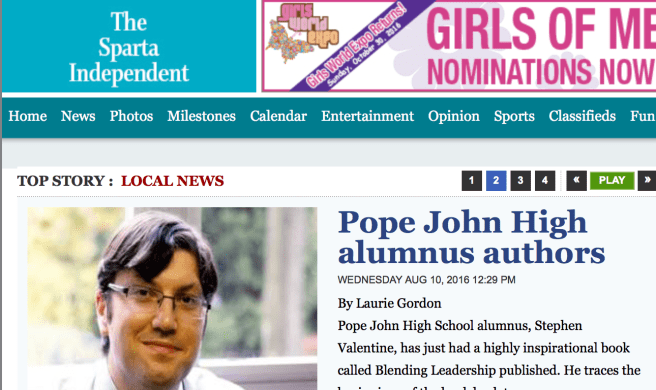
Here are her questions and my answers:
I know you grew up in Jefferson. How did you come to go to Pope John High School?
I attended the Jefferson Public School system from kindergarten through eight grade, and I loved it. I had some great teachers and close friends, and by the time eighth grade rolled around, I definitely had a clear path forward in the high school. I was going to play saxophone in the band, run cross country, play basketball, and pitch for the baseball team. But that narrative started to change in my head when my parents casually presented Pope John as an option.
Looking back, the decision to go to Pope John instead of Jefferson seems almost unfathomable. All my friends, my entire life, was in Jefferson. I lived in Jefferson, grew up fishing in the White Rock Lake and rooting for the high school football team. I don’t know how I had the courage to leave all of that.
What I can say is that the decision to go to Pope John immediately intensified my life because it put me at the nexus of some very serious local rivalries — Pope John had Sparta on one side and Jefferson on the other, and there was fierce competition with both schools. I think that, on some level, I was drawn to that kind of intensity. It certainly made for good drama!
There was also part of me that had a little bit of a romantic streak. I still do. I knew that if I went to Pope John I was going to be embarking on a true adventure because I didn’t know anybody there. I was going to have to figure things out for myself. I was going to have to prove myself all over again, and in doing so, define who I truly wanted to be.
I was on track to be successful at Jefferson. I knew all the key players, and certain doors were being held open for me. But I walked away from all of that into a great unknown — and from that point on, I got to make my own decisions about who I was. I got to write my own future.
Please trace your collegiate and post-collegiate studies and talk about how you ended up in the field of education.
I went to Boston College, and by the time I stepped foot onto campus I knew that I wanted to be a writer and to study English. I had reached out to the poetry professor there, Suzanne Matson, and sent her some of my work. I told her that I wanted to be in her advanced studies class, and she was receptive and encouraging. I ended up taking her class twice.
I took as many English classes as I could get my hands on, and I ended up following my interest all the way to Oxford University in England, where I spent my entire junior year. I would say that’s where wayward desire turned into legitimate productivity because I was plugged into the Oxford tutorial system — and that meant I had to write, a lot, each week. I didn’t have to attend classes. Instead, I had to write a ten-page paper each week and read it out loud to an Oxford Don during a one-on-one meeting. He or she would take notes and then tear into my arguments, my logic, my sources — point by point, almost sentence by sentence. I had to defend my research. I had to defend my word choice and my syntax. This process probably sounds painful to some of your readers, but I loved it. It forced me to learn to think and express my thinking — and it made me immune to believing my writing was somehow precious or priceless.
When I got back to Boston College, I immediately elected to write a senior thesis. I wrote about William Blake, and once Blake had his hooks in me, I couldn’t put him down. I went directly to graduate school at University of Virginia with the intention of writing and learning more about Blake.
Toward the end of graduate school, I decided to enter the one profession where I could continue to think and talk about books. I became an English teacher with a full-blown writing habit, or on the flip side, a writer with a full-blown teaching habit. I have never liked to separate teaching and writing. One feeds the other.
What were your jobs prior to Montclair Kimberly Academy?


 Refreshing Wednesday, LLC