Thinking Big vs. Doing Small

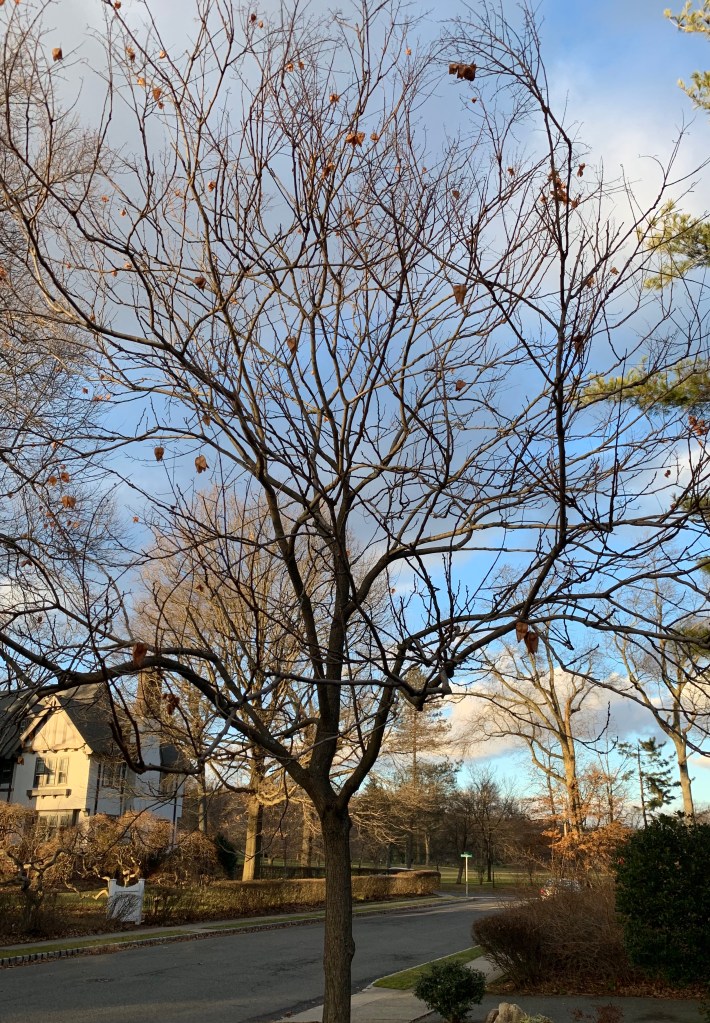
I’m not at all a photographer, but I’ve been taking pictures lately. I’m trying to be deliberate about lighting and angles and my subjects. I’m trying to keep things simple and the assignment (i.e., time commitment) as small as possible: take at least one picture of a tree every day. Here’s what’s happening:

First, I’m seeing the world differently. Already. After only a week of my new hobby, I’m much more aware — than ever before in my entire life — about the way light shows up, or hides, in the world. I’m also experiencing a not altogether unpleasant version of FOMO. Sometimes, I’ll be in a building and I’ll catch a glimpse of a particular moment during a particular day and I’ll think — again, for the first time in my entire life — “the weather outside seems perfect for a photograph.” Sometimes I sneak out and snap a quick picture.

I expect that the above sounds slightly smarmy to anyone who has ever taken a photography course or bothered to learn how to use a camera, but my point in sharing has less to do with my newly acquired perspective and more to do with the fact that I’m succeeding in seeing the world in a new way by simply committing to a new serial project: take at least one picture of a tree every day.

For those of you who have recently made a New Year’s resolution, I would ask this: is it a resolution that resembles the “see the world in a new way” kind of thinking or the “take at least one picture every day” kind of doing? In terms of actual change, of actual progress, the distinction matters. The former, an aspirational thought, might not lead to the latter, a functional behavior. But the latter, a functional behavior, often leads to the former, an aspirational thought.

Or at least that’s what I’ve learned over the past few cycles of my New Year’s resolutions.
The Every Time Opportunity

I try to read Ellen McGirt’s newsletter everyday when it arrives in my inbox. Today, she offered some general guidance (along with a lot of meaningful specifics) about speeches and speechmaking. Here’s a useful reminder for anyone within arm’s length of a microphone:

[Every] time someone steps up to deliver even semi-formal remarks, it’s an opportunity. To be human and transparent, to declare a value you embrace, to encourage people to act, to think, to see themselves as part of something bigger.

Here’s the full text and my source.

A First Principle for Productivity

First principle: Schedule work blocks (not just meetings or appointments) and then honor those commitments when they appear on your calendar. It’s easy to keep an appointment with other people, especially if they show up in your office at an agreed-upon time. It’s much more difficult to keep an appointment with yourself wherein, say, you’ve set aside time to read something important or write something or synthesize your notes from a meeting.

If you become an expert at applying the above principle, you will become more productive because, as you develop certain goals or aspirations, you will immediately schedule the work blocks it will take to complete them or reach them. And then, when you keep those appointments, the work will add up, the work will get done.

Additionally, you will become a more effective collaborator, in part because, when someone asks you to do something, you will be able to quickly tell him/her: “I’ll handle ______ on _______.” Communicating about the scheduled work will help to settle your partner, allowing him or her to move on to other tasks. And actually delivering on your promise to complete said work at said time, again and again, will build the kind of trust that allows collaborative work to flourish.

Automated Emails: The Yearly Purge

I dug into my professional email today after mainly ignoring it (except for quick “emergency scans”) since my vacation started in earnest on December 22.

As is typical for this time of year, I was able to delete quickly (i.e., without reading) ~half the messages in my untended inbox. They were from accounts that send automated emails to me daily, weekly, monthly, or randomly. This means I either subscribed to the email or someone added me to a list without my permission.

As I delete quickly, I consider slowly the value of these automated communications. Here are the questions I typically ask myself:

  • Did I subscribe to this automated email, and do I read it and derive value from it? (If yes, then I keep the subscription.)
  • Did I subscribe to this automated email, and have I stopped reading it? (This case is more tricky because I might want to continue seeing the automated emails in order to keep a person or organization on my radar. But I’m trying to be more vigilant this year, so I’m cutting out most subscriptions that I haven’t opened or read in the past few months. If they’re worth my attention, I’m guessing, they will find their way back onto my radar.)
  • If I never subscribed to the automated email, I unsubscribe unless the content has been interesting to me. (It takes a lot for me to maintain an “email relationship” with a person or group that added me to a list without first seeking my permission, but I’m not a snob about such things. If I attend your conference, you can consider that permission to continue telling me about the conference in the future. If I subscribe to your newsletter and you want to add me to a new list, that’s fine, too. If we meet in person and have an interesting conversation, I’d love to see your newsletter.)

That whole process takes about 35 minutes and leaves me with the emails in my inbox that can be considered “ill structured,” in that they require more personal attention, more creativity, sometimes more tact. I’ll answer half of them tomorrow and half of them the day after that, which will allow me to head back to work in the new year with a clean inbox.

Houseguests

We’re nearing the end of a long stretch of houseguests, ranging in age from <1 to >70. I’m glad to have the memories, but I’m also finding that I’m glad to have the new knowledge that comes with inviting people into a space with which I am very familiar and within which I have many well worn routines and habits.

Guests open windows that you have never opened, cook in ways you never would if left to your own devices and kitchen, and sometimes show you exactly how loud your stereo is capable of playing. They pull you into stores in your town that you have walked or driven past a hundred times, they ask familiar clerks unfamiliar questions, and coming in from some quiet time on you back steps, they tell you how beautiful that view — that you’ve simply grown used to — really is.

With those thoughts in mind, I was pleased to see that Reshan Richards jumpstarted his blog today. He’s been a houseguest — in my actual house, yes, but more often in my inbox or Zoom window or telephone — on so many occasions over the past few years, rearranging my mental furniture and helping me to see new uses for old things, and perhaps more important, new things for old uses. He’ll do the same for you.

Teaching and Business

Fundamentally, a teacher is someone who’s good at seeing meaning and patterns and then being able to explain them in a way that’s simple and accessible. I think I’ve been successful — as an entrepreneur, as a business leader, as a marketer — because, fundamentally, I’m a good teacher. It all kind of comes down to that.

~Danny Iny in a recent interview we conducted with him

Art

After allowing yourself to be very curious about the world, and to document what you notice, make the best thing you can.  Design.   

Find a way to reproduce it.  Design + Production.  

Price it fairly and put it in a “store window.”  Design + Production + Commerce.

Make other, smaller, secondary things that emanate from the same spirit, intelligence, and voice that created the first thing.  Design + Production + Commerce + Marketing.  

These could include: Talking to interesting people about the first thing and publishing the conversation.  Noticing and blogging about things that should have been part of the first thing but were not, due to time constraints.  Identifying and tweeting about things that contradict the first thing.  Designing infographics that explain the first thing.  Speaking into microphones about the first thing.  Inviting others to write about the first thing.  Riffing on the first thing.  Basically, following the curiosity that led to the first thing wherever it wants to go.  Marketing is Further Making.

Give away the smaller, secondary things, for free, sharing them broadly, tying all of them back to the first thing.

(The reason for the tying back is that the financial success of the first thing becomes fuel for the secondary things, justifying further investment in the curiosity that led to the first thing in the first place.)

The arc of all of this work, should it continue long enough, will naturally create a third thing — a combination of the first thing and the secondary things.  Art.