Practical Vocabulary

The Zeigarnik Effect, as defined by Cal Newport in the amazing to contemplate and difficult to apply Deep Work, is as follows:

This effect, which is named for the experimental work of the early-twentieth-century psychologist Bluma Zeigarnik, describes the ability of incomplete tasks to dominate our attention.  It tells us that if you simply stop whatever you are doing at five p.m. and declare, “I’m done with work until tomorrow,” you’ll likely struggle to keep your mind clear of professional issues, as the many obligations left unresolved in your mind will, as in Bluma Zeigarnik’s experiments, keep battling for your attention throughout the evening (a battle that they’ll often win).  152 – 153

It strikes me that David Allen’s entire Getting Things Done system is an effort to battle this particular effect.  He encourages us to write things down in a trusted system so that they do not linger in our minds.  Cal Newport also presents some nice fortifications against malingering tasks, but I won’t summarize them for you because I recommend you read Deep Work in its entirety.

After reading the Stoic philosophers all summer . . .

I found this quotation by Alan Jacobs (with an assist by the best passer in the game, Austin Kleon):

Remember Pascal’s warning against the error of Stoicism, which is to believe that you can do always what you can really only do sometimes.

It’s important because it’s of the “work-hard-but-forgive-yourself-when-things-don’t-go-as planned-because-after all-you’re-only-human” variety.  Source is Snakes and Ladders, where Alan Jacobs records “stray random thoughts.”

About (more than) Andreesen Horowitz

jGvHRW6p_400x400.png

I was recently reading the “About” page on the Andreesen Horowitz website.  I found myself there because I was trying to learn more about Ben Horowitz, whose insights often come across my screen / desk.  I really like the way AH clearly breaks up, and defines, its team around certain functions.  And I also really like how they articulate “Operations” and the fact that they have a “Professor in Residence.”

  • Investing: Backing brilliant entrepreneurs to build the future.
  • Market Development: Accelerating time to market and matching corporate partners with emerging technology leaders.
  • Technical Talent: Creating the definitive network of technical superstars, and developing the right program to support your people.
  • Executive Talent: Connecting and counseling industry leaders.
  • Marketing: Building awareness, and offering guidance through all the brandbuilding events an entrepreneur faces.
  • Corporate Development: Helping companies plan their financial and strategic futures.
  • Policy and Regulatory Affairs: connecting technology companies with the resources to navigate the regulatory landscape.
  • Operations: Ensuring a first class experience for everyone who interacts with the firm.
  • Board Partners: Experienced operators and accomplished technologists.
  • Special Advisors: Bringing to bear deep expertise.
  • Professor in Residence: Our liaison to academia helping transfers breakthrough from the lab to the market.

Unhook from the Anchors

Last week, I attended a meeting with Reshan Richards.  During the meeting, we — the group — got stuck twice.

Both times, Reshan helped us to get unstuck by offering a very simple, very deft nudge.  He suggested that maybe we were using the wrong name for the problem we were trying to solve.

Once we abandoned the old name for the problem, we found that we weren’t stuck with the same associations, the same ready-made solutions, the same paths.  In both cases, we found desirable outcomes.

Though I’m sure Reshan wasn’t deliberately thinking about psychology — he was just being creative and disruptive, as is his instinct — the efficacy of the move he made can be traced to an undoing of the “anchoring effect.”

In Thinking Fast and Slow, Daniel Kahneman explains it this way:

[The anchoring effect] occurs when people consider a particular value for an unknown quantity before estimating that quantity.  What happens is one of the most reliable and robust results of experimental psychology: the estimates stay close to the number that people considered — hence the image of the anchor.  If you are asked whether Gandhi was more than 114 years old when he died you will end up with a much higher estimate of his age at death than you would if the anchoring question referred to death at 35. . . .  Any number that you are asked to consider as a possible solution to an estimate problem will induce an anchoring effect. (119 – 120)

Creative and agile leaders, it follows, will be able to spot anchors, understand their effect, and help others to shed them when they establish unhelpful limitations or hinder progress.

Trust Yourself to Greatness

41bgSt-6+uL._SX331_BO1,204,203,200_.jpg

I had breakfast with one of my advisees yesterday.  He’s heading into his senior year, and he’s putting a lot of pressure on himself to perform at a very high level across a variety of domains and challenges. Newspaper editor, captain of a team, leader of several clubs, heavy academic schedule: you name it, this kid’s doing it. As we left the restaurant, I found myself saying the same things I’ve said to so many young people over the years:

Me: “Have you put in the work?”  Have you practiced as hard as you can?”

Him: “Yes.”

Me: “Then you just have to show up [at the contest / test / game / interview / etc.] and do your best.  If you’ve done the work, then you just have to let yourself play the way you’ve prepared to play.”

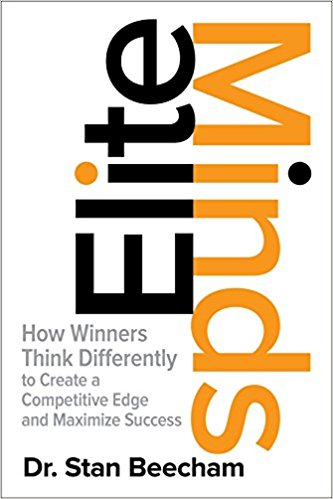
Today while reading a book called Elite Minds by Dr. Stan Beecham, I found a more eloquent (and studied) version of the above.  As you return to school, and find yourself having similar conversations with the young people in your care, please share it. So many of them are harboring big dreams and a little bit of fear that, when they get up to bat, they won’t be able to hit the ball.  Here’s Dr. Beecham:

Performing at the highest level is not about talent, ability, size, speed, facilities, equipment, weather conditions, or even effort.  It’s about being free.  Free from expectations of self and others, free from criticism, free from fear, and free from “should” and “have to.”

There are many routes to success.  So you shouldn’t be overly invested in a specific outcome or result.  If you are, this will bite you every time.  Freedom means no attachments, no desires, just one very quiet mind that allows you to perform at the best of your natural abilities that have been instilled in you during intentional practice.

When athletes have a great performance, they frequently find themselves being interviewed after the competition.  The interviewer asks a series of questions to discern how they did it. . . .  Usually the athletes start and stop a number of times because, quite frankly, they don’t know the answer to the questions.  Their mind was not thinking.  They were reacting, seeing, feeling, but definitely not thinking.  In most cases, they won’t be able to tell you what happened or how they did it.  Instead, it just happened.  There is very little memory of the event, and time and space tend to be distorted as well.  It was absence, not presence, that had allowed the wonderful to happen.

You must trust yourself and your ability in order to perform at that level.  Ultimately, you can’t will yourself to greatness, but you can trust yourself to greatness if you’ve done your preparation. (152 – 153)

I think this message resonates with me so deeply because I trust so many of the young people with whom I work.  And now I see that it’s my job to help them trust themselves.

On a Very Clean Desk

I keep a very clean desk in my home office.  (It’s almost the opposite of my desk at work.)

For some reason, no matter how many times I clean off the desk, I leave the following quote from Teju Cole:

What makes an image surreal is not the artful crafting of illusion but the eruption of the accidental into the everyday.

It’s not taped to the wall or the desk.  It’s not framed.  It’s just written on a page I tore out of a magazine I found in an airplane.  Last time I flew to California…

Building a Town from Scratch

In his book On Trails, Robert Moor reports on a conversation he had with J.L. Deneubourg, a leading thinker on ant behavior, and according to Moor, a “veteran collective intelligence researcher.”

When Moor asked him how he would use his vast knowledge to organize and construct a better city from scratch, Deneubourg replied: “I would like to see the emergence of the town . . . If I was mayor — and the probability of that happening is quite low — my attitude would be very liberal.  My objective would be to offer different types of material to help citizens find the solution that they prefer.”

When Moor asked him to clarify — would he indeed “withhold his expertise and allow the town’s resident’s to plan their own town?” — Deneubourg said, “Yes . . . To believe that you have the solution for another person is a form of stupidity” (86).

This quotation arrives in my life at an interesting time — when I’m about to begin planning my 9th Grade English class.