The Professional Mistake Maker

Today I returned graded work for the first time to my new ninth grade English class.  I always find this moment — a reminder of the somewhat (disappointingly) transactional nature of school — a little rough.

Before distributing the work, I decided to share a few minutes (roughly 8:29 – 13:00) of a podcast that Tim Ferriss recently recorded with hedge fund mastermind Ray Dalio.  I asked students to listen to the segment and to try to figure out how it was related to the feedback process at school.  My question: What does Ray Dalio, hedge fund billionaire, have to do with the feedback I have just put on your papers?

The podcast felt like a risk.  I wasn’t sure how my students would respond to two men talking about investing*.  But as soon as I heard Dalio’s Long Island accent and watched the students lean toward the computer speaker, I knew I had made a good choice.  After I stopped the recording, the students instantly started talking about the importance of humility (which Dalio mentions) in improvement, how we should strive to convert mistakes into wisdom, and the fact that Dalio’s formula (pain + reflection = progress) seems valuable for the endeavor of being a student, both in school and out.

When one student looked up Dalio’s astronomical net worth and mentioned it to the class, another student said, “and he says he got there because he’s a professional mistake maker.”  I think there’s a good lesson in there somewhere.
Lessons from the Lemonade Stand

On Sunday, my daughter set up a lemonade stand for the very first time.  She handled everything — buying lemons, standing in line at the bank to get change, making a sign — and ultimately made a small profit that included a two dollar bill. But heading into late morning on Saturday, I was more than a little bit worried about the endeavor because my daughter, being 8, seemed to think that a lemonade stand and homemade lemonade would appear at the simple snap of her fingers.

As I tried to explain all the steps involved, she lost interest and I became frustrated.  I was facing a very typical teaching / parenting challenge: how on earth can I move what’s in my brain into the brain of my student / daughter?  How can I help her to see what I know to be true?

That’s when I reached for my iPAd and handed it to her.  I knew the tool would attract her attention.  And, beyond that, I knew it would slow both of us down enough to help us do some real planning.

She opened Explain Everything, and we worked in one slide at a time to trace the process from ingredients to first sale.  Because she had to draw almost everything, she had to literally visualize each step.  By the time we were finished, she was fully in command of the 25+ steps it would take for her to turn her vision into reality.  She took me by the hand and led me through the rest of the day, telling us where we needed to go and what we needed to do.  By Sunday afternoon, she was ready to go.

I sometimes hesitate to pick up my iPad because I’m not fluent enough in the tools it offers to use it to capture my thinking.  I admit that.  But I have to continually remind myself that, as a teacher / parent, my thinking isn’t what’s most important.  Whatever helps my student / child think best — understanding the problem she is trying to solve and her own agency in seeking solutions — is the tool I should try to provide.  If I don’t do that, then I’m simply in the way, maybe even part of the problem.

Helping Me Help You Helps Me

In a one-on-one meeting today, one of my colleagues said, “I’d like you to hold me accountable for ____________.”  Then we discussed her request and why she made it in the first place.  We did some preliminary problem solving.  And then I left the meeting and made a note in my calendar to check in with her about the topic in a future meeting.

A school or organization’s culture is really humming along when leadership and followership dissolve into something more like partnership.  As the nominal leader in this situation, I felt great about discovering where to focus my energy and attentional filters as they relate to this colleague.  By helping me to focus, she helped me to help her, which is what I want to do more than anything else for the people with whom I work.  Therefore, she helped me.

How I Connected with People Today

Facetime (1)
Email (>50)
Face-to-Face group meeting (3)
Twitter (5)
LinkedIn (2)
Text (7)
Calendly (1)
Phone (2)
Face-to-Face, One-on-One meeting (5)
Zoom (1)
Youcanbook.me (1)
Wordpress (1)

I tried to be the same me in every space, to offer the same value regardless of time, path, place, or mode. The trick, I’ve found, to doing that is to concentrate as much as you can on the person on the other end of the phone, Zoom link, meeting room, etc.  Forgetting the medium is easy when you are really focusing on the connection that the medium makes possible.

Stephens on Writing via Pink

In his newly enhanced newsletter, Dan Pink suggests a short column by Op-Ed writer Bret Stephens.  It’s about writing — tips about writing op-eds to be precise.  Here’s some of the advice that I think is worth keeping.

Cliches are bad.  We know this.  Stephens avoids the cliche in cliche bashing by comparing cliches to Velveeta cheese (for chefs) and noting that they are “indicative of the mental slop that lies beneath.”  Ouch and indeed.

“If you find writing easy, you’re doing it wrong.”  Pink loved that sentence, and I’d add that it’s exactly right most of the time.

Stephens ends well, too: “I’d wish you luck,” he writes, “but good writing depends on conscious choice, not luck.  Make good choices.”

I’ve read and edited a mountain of writing.  Ninth grade essays on Lord of the Flies, college admissions essays, the writing of college students, graduate students, and high school administrators.  I’ve read and edited stories from third graders and aspiring sixty-year-old poets.  I’ve edited police blotters and high school literary magazines.  The writers worth reading make conscious choices.

They use vowel-loaded words when they’re talking about rivers and hard consonants when they’re feeling upset or broken. Even if their choices aren’t great, the fact that they choose words carefully, consider sentence lengths, and wrestle with imagery and symbolism signals an acute resistance of automaticity and the urge to tell too much.  They disrupt silence, in other words, reluctantly and reverently.  Kerouac and Ginsberg were heroes to me once, but their “first though, best thought” method was, is, and will be . . . bunk.

How People Are Working (Right Now)

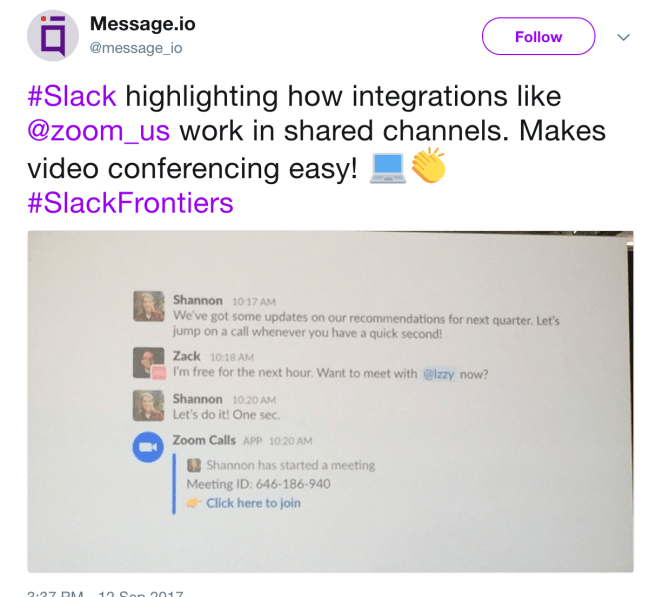
I saw this “in the wild” today.”* **  ***

Screen Shot 2017-09-12 at 6.05.23 PM


*The degree to which people can share their work processes today never ceases to amaze me.

**As a teacher, I love the just-in-time opportunity that this opens up.

***I also love the leadership instinct that’s present in this example.  You can watch the the leader in the conversation emerge as she suggests the best way to connect, serving the present task by choosing the best tool at the best time.

Practice Makes Practice

I was raised in a household where practice was seen as a church in which you prayed to your own potential. Practice was a gift, giving you an opportunity to develop a new skill, connect to a new group of people, or come one step closer to mastering a craft.

My upbringing is perhaps why I’m so excited to be back in school. . . .  Schools are filled with many different types of people and groups, many different types of problems and possibilities.  At base, then, every educator has a chance to practice what is perhaps the most fundamental human act — communicating.

Every time you stand in front of a classroom or in the center of a huddle; every time a student shares hard or good news with you; every time a parent is anxious or asks a tough question, you have the chance to practice communicating.  To get better at it.  To have the opportunity to keep practicing.

No Big Deal

A few days ago, I approached the copier near my office and started to key in my email address.  I was doing what I had done many times before — setting up the machine to generate a scanned document that would then be sent to my email inbox.

This time, as I started typing the first few letters of my email address, the address auto-filled.  This saved me a few seconds (or more, depending on typos) and felt like a small gift from the universe.

Today, a colleague was attempting the same process and the same thing happened.  He let out a literal yelp of joy.  When I asked him what happened, he told me, and one of our new colleagues overheard us talking.  She said, “I auto-programmed your emails into the copier to save you time.  It was really no big deal.”

“No big deal” is often quite rare . . . like other small kindnesses, courtesies, and supportive gestures that make certain workplaces so quietly special, so patently human.

The Act Begets the Act

In the book Deep Work, the author talks about the fact that there are several reasons to perform deep work.  One (under-appreciated) reason to work deeply is that, in working deeply, you build up the stamina and ability to work deeply.  The act begets the act.

I feel the same way about blogging each weekday based on a simple prompt: what is something that I noticed today?  By writing about what I notice, I build up the capacity to notice.  The noticing muscle gets stronger.  Not necessarily better, but stronger.  The act begets the act.