The Opportunity Mindset of Kyrie Irving

Several years ago, I had a powerful experience in the woods.  I was chaperoning a group of sophomore boys on a retreat-style field trip to help them form a bond before the start of the school year.  As we proceeded throughout the day, I became increasingly anxious — I knew that our culminating experience would involve a high ropes course . . . and that I would be asked to participate . . . and that my fear of heights could cause me to freeze up, embarrassingly, at some point on the course.  I imagined myself, these boys’ role model, huddled up and shaking on a tiny platform nailed to a tall tree.

Our guide that day was an easygoing, athletic man who was completely at home in the woods.  As he loped along, flowing through the trails like water, he told stories about his former life on Wall Street.  I enjoyed listening to him because each story presented him in a humble light and had some kind of deeper point.  He was good at his new job and clearly knew it was a blessing afforded by his old job.

At one point, I finally confessed.  My students were increasingly laughing and joking about the upcoming ropes course, and their boldness somehow only amplified my anxiousness.  I told our guide, out of earshot of the young bucks, that I had to find a way to avoid the ropes course.  And could he help me.

He paused the long pause of the wise.  He may have even stroked his salt and pepper beard.  (Yes, this was one of those archetypal moments!)  And then he told me something that I have never forgotten.  After affirming that I was, in fact, very nervous, he said, “Good.  If you’re nervous then that means your body is primed for action.  All you have to do is rename the nervousness.”

“Okay, I’m panicked,” I said, “not quite understanding.”

“Wrong name,” he countered.  “You’re not nervous or panicked . . . you’re excited.  Try that instead.  Try thinking that.  Try saying it.”

As we talked some more, he explained that excellent performers in all walks of life are often nervous before their big performances.  But, through long training, they find a way to repeatedly convert nervousness into fuel.  They find a way to feed off of nervous energy by using it for excitement, pep, a burst of power.

Long blog post short, his advice worked.  It wasn’t perfect — my legs still shook and my breath still raced as I worked through the ropes course — but I didn’t embarrass myself.  What’s more, I actually performed quite well during the challenge.  Since then, I’ve used the renaming technique dozens of times, most directly before I speak in public.  I now look forward to the surge of energy that comes with difficult professional challenges — and I only really worry when I’m not a little worried before something big.

I wasn’t surprised, then, when I heard about a concept called “anxious reappraisal.”  Writing for The Atlantic, Olga Khazan explains:

[Anxiety] and excitement are both aroused emotions.  In both, the heart beats faster, cortisol surges, and the body prepares for action. . . .  The only difference is that excitement is a positive emotion, focused on all the ways something could go well.

According to Khazan, anxiety “reframed as excitement” can lead to better performance by helping you, the performer, “focus on all the good things that can happen if you do well” as opposed to dwelling “on all the consequences of performing poorly.”

I had both of these stories on my mind when I did a quick Google search of Kyrie Irving, something I’ve been doing every few days since his move to the Boston Celtics.  I’ve had a hunch that his success this season is at least in part a result of a deep commitment to the mental side of the game.

In an article for ESPN, Chris Forsburg pointed to a “gushing monologue” from Irving about “his love of the fourth quarter,” or what Forsburg calls “the final frame.”  It’s a pitch perfect example of what Khazan describes in her article.  It’s the essence of “the opportunity mindset” made visible.

It’s go-time . . . Especially when the game’s in the balance, it’s the best time to play. Just ultimate freedom, just to really showcase what you’ve been working on because you know that you’re going to get the team’s best shot on the other end . . . Some guys think a lot quicker than others. I was just fortunate enough that my mind works a lot quicker than other people in the fourth quarter . . . So it just gets me going a little bit. Especially when it’s a close game, there’s just nothing like it. NBA, every crowd’s going, whether home or away — there’s just nothing better. I love playing in those type of situations.

It’s instructive to read Irving’s statement with Khazan (and my long, lost tour guide) in the back of your mind.  He’s in phenomenal physical shape, for sure, but his mind is sharp, too, helping him to see a highly stressful situation as “go-time” and “the best time to play.”  Going a step further, he sees it as “ultimate freedom,” which is at or near humankind’s highest aspiration.  It allows him to “showcase” all the practice he has done and makes him feel “fortunate,” and like the most special version of himself (“my mind works a lot quicker than other people”).  It’s possible to say that he’s one of the most clutch players in the NBA right now because he thinks about, and loves, the clutch moment in the most optimal way possible.


Special thanks to Jon Seipp, who runs a book club for Boston College alumni and shared the Khazan article, and Tony Jones, for nurturing my slow hunches about the mental side of Irving’s game. For more on this topic, here’s a related post about the work of Dr. Stan Beecham.

Joe DiMaggio, Charlie Parker, and the Uses of Practice

In the car this morning, I was listening to Phil Schaap, one of the world’s leading jazz historians. At one point, he made a comparison between Joe DiMaggio and Charlie Parker.

Around the same time in history, they both decided to use recording equipment, which was very expensive at the time, to record their practice sessions.  Nothing about this process was easy, but both men felt that recording their practice would help them to improve.  (Who can argue with the results?)

Schaap said that DiMaggio used his recordings to try to build his swing; recording his batting practice allowed him to watch himself during those times when he couldn’t be in an actual batting cage. So it allowed him to continue to work on his swing even when he didn’t have a bat in his hands.

For Charlie Parker, the purpose of recording himself practicing was slightly different. Like DiMaggio, he certainly wanted to be able to hear himself playing so as to be able to make adjustments. But he also wanted to capture, for his listeners, the evolution of his sound. DiMaggio wasn’t interested in sharing with his fans every single time he whiffed during batting practice, which is understandable. There’s nothing to see in those reps, especially since DiMaggio was aiming for a consistency that would lead to greatness.

But for an artist like Charlie Parker — who was constantly seeking to break new ground, to evolve, and to find a new sound — his practice sessions were windows into a vision. Seeing through those windows would help his fans to better understand him, deepening a relationship that, for Parker, was essential.

At any rate, I’m often fascinated by those moments when a young person decides that he/she wants to be better than all the rest and then figures out a way to practice that actually delivers the results he/she seeks.  There’s hard work and then there’s smart work.  And then there’s hard, smart work.

Drawing Out a Discussion

As a systematic part of my school’s Professional Growth Program, teachers visit other teacher’s classrooms in order to learn something and celebrate the work of their colleagues.  Today, I visited a class where the teacher sometimes uses the Harkness Method to generate open discussions about relevant class material.  Our school does not subscribe fully to the Harkness method, so I wanted to see what it would look like.

The teacher started in what I thought was a great way — he asked the class to reflect on their prior Harkness-style discussions.  What had worked and what hadn’t worked?  The students were incredibly articulate about the parts of the process that were broken and what they might do to fix those parts.

In the end, in a nutshell, the problem was simple and actually quite positive: first, most of them wanted to share their ideas; second, most of them had moments in class where they felt passionately enough about an idea that they wanted to say it even if it meant that they would be talking over another classmate.  There was a healthy intellectual competitiveness in the room which meant that many of the students felt like they had to vie for air space.

As far as classroom problems go, that’s all okay with me . . . especially when the teacher is also trying to help the students understand the fact that (a) group dialogue is important and (b) by definition, group dialogue can’t necessarily include every single idea that every single person thinks at every single moment.  In the class, I could see intellectual passion bumping up against intellectual discipline.  I could see students beginning to understand the power of cohorts.  I could see very fine “school” unfolding.

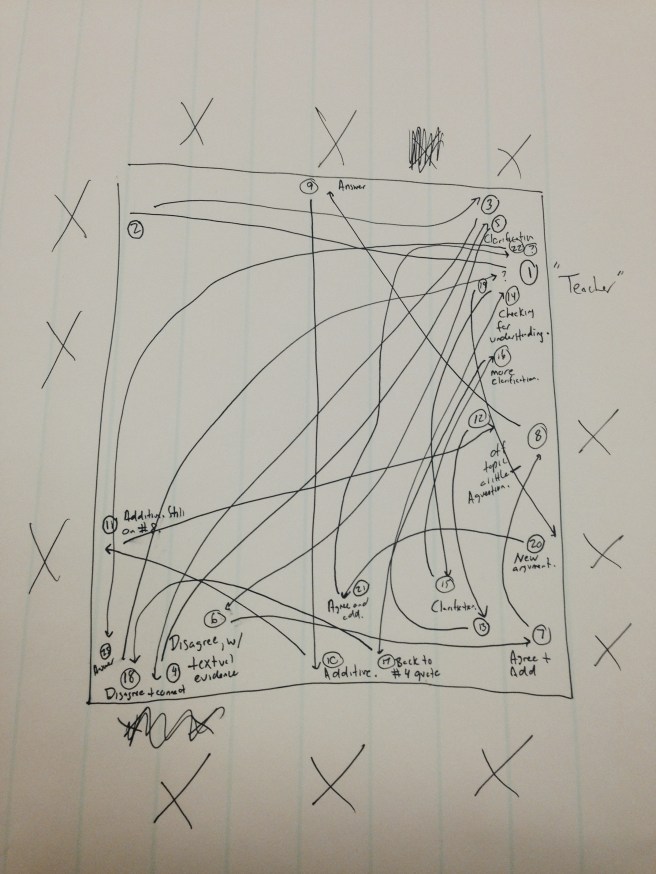
When I left, I handed the students this diagram, which I sketched — coarsely — while listening and learning.

FullSizeRender.jpg

Mister Buckminster

Here’s a quotation from Buckminster Fuller that I discovered while reading something that Peter Senge wrote:

If you want to change how a person thinks, give up.  You cannot change how another person thinks.  Give them a tool the use of which will gradually lead them to think differently.

In my experience, that’s pretty accurate.

All Hail

“The discipline of sharing something daily is priceless.” That quotation comes from what I’m sharing today: Seth Godin’s 7000th blog post.

I’m not sharing this post because I think I’m going to introduce you to Seth Godin’s work (although that would certainly be a good day’s work); you’ve most likely heard of him and learned from him already.

I’m sharing this post, instead, to simply say a very public thank you to an author who has made a high art of generosity, connectivity, discipline, and gratitude.  I honestly can’t even count the number of times when one of his sentences has helped me to approach a problem from a new angle, to get unstuck, or to stumble upon a new flavor of joy, purpose, or potential.

Art.  Work.  Seth.  Godin.

Late October / Early November, as Usual

Late October / Early November, as usual, has been a bear, and I’ve forgotten, as I often do, the one piece of wisdom that I’ve picked up in the past decade — sometimes, when your plate is completely full, the best thing to do is to add something to it.

I’m not talking about any kind of something.  I’m not suggesting that you spend more time emailing or on the phone or in meetings; I’m not suggesting that you rake more leaves or spend more time sweeping the pine needles off your driveway.  Those are the activities that are grinding your gears in the first place.  I’m talking about any of the following.

  1. Spend a few minutes actively reflecting on your life.  That is, write in a journal, write a letter, draw a picture.  The act of writing about disparate elements can often help you to make meaning of things, which makes them feel less disparate.  Three unconnected things equals three things; three connected things equals one thing.
  2. Walk, run, or bike . . . flushing the system makes the system work better.
  3. Attend a performance or sporting event that features a family member or friend.  Turn off your phone and leave your calendar behind.  Focus on the event and your family members / friend’s role in it.  Go for whatever ride — physical, emotional, spiritual — they seem to be going on.  When they are breathless, be breathless, etc.
  4. Help someone else with something.  It doesn’t matter if you fully understand the problem — just role up your sleeves and shrink someone else’s burden, get tangled up in their tangle, leave them a notch or two lighter and looser.

I’m not sure why, but these activities feel additive in the purest way possible.  Though they take up time, though they stretch your available resources, they ultimately add energy, time, meaning, and life to your days.  Expanding the day, they make the day a little bit easier.  I’m not sure why, but I just tried a few of them — #1 and # 4 — and they worked.

“Quotation Marks.” Period.

While editing this month’s Klingbrief, I looked up a rule about quotation marks. I frequently encounter very insightful, bright writers who approach end punctuation very differently when they are using quotations.  Today, I finally decided to do some research.

It turns out, both camps are right, and one’s geographical orientation matters in resolving such disputes.

The Grammar Girl website adds a wonderful note to settle the debate; I offer it to you today as an example of (1) how an initial decision can lead to a profound domino effect and (2) the ways in which thoughtful interventions can (sometimes) halt or redirect habits.

Compositors―people who layout printed material with type―made the original rule that placed periods and commas inside quotation marks to protect the small metal pieces of type from breaking off the end of the sentence. The quotation marks protected the commas and periods. In the early 1900s, it appears that the Fowler brothers (who wrote a famous British style guide called The King’s English) began lobbying to make the rules more about logic and less about the mechanics of typesetting. They won the British battle, but Americans didn’t adopt the change. That’s why we have different styles.

According to this interpretation, American-style punctuation at the ends of quoted sentences reflects a choice made during the days of metal type, while British-style punctuation at the ends of quoted sentences reflects an intervention based on logic.

So I guess the next time a student challenges me by saying that some grammar rules seem to be arbitrary and even illogical, I will have to be honest and reply, “that’s true, but only in America!”

Dailyo Discipline

Add Ray Dalio to the list of people who write (or blog) everyday.  In his new book, Principles, he talks about his process and the rationale behind it.

In the late 1970s, I began sending my observations about the markets to clients via telex.  The genesis of these Daily Observations was pretty simple.  While our primary business was in managing risk exposures, our clients also called to pick my brain about the markets.  Taking those calls became time-consuming, so I decided it would be more efficient to write down my thoughts every day so others could understand my logic and help improve it.  It was a good discipline since it forced me to research and reflect every day.  It also became a key channel of communication for our business.  Today, almost forty years and ten thousand publications later, our Daily Observations are read, reflected on, and argued about by clients and policymakers around the world.