Unbundling?

Fortune recently put out its list of the “The World’s 50 Greatest Leaders.”  One common theme in these leaders’ behavior, according to the authors of the article, is that they have “[harnessed] the power of unbundling.”  Here’s an extended quotation about that term:

Unbundling means disaggregating enterprises of all kinds, from the smallest startups to entire nations. In business it can mean making a company more valuable by splitting it up, as Hewlett-Packard did and other companies (Honeywell, Pentair, DowDuPont) are doing. Or it can mean increasing value by delegating functions once regarded as necessary parts of the whole; Apple’s outsourcing of complex, high-tech manufacturing, and the staggering capital requirements that go with it, is a dramatic example.

Technology makes unbundling possible and often inevitable. For centuries, greater size made companies, nations, and other enterprises more efficient and effective. Increasingly, it doesn’t. Outsourcing and coordinating manufacturing, distribution, research, and nonemployee workers becomes easy and cheap in the digital era. The most extreme example is the Chinese appliance maker Haier, which is not so much a company as a platform that invites entrepreneurs to become one of thousands of microenterprises within its ecosystem. Crazy? Definitely not. Using this radically unbundled model, Haier has become the world’s largest appliance brand.

So now I’m thinking about what this would look like in schools . . . and if it’s right for us.

A Simple Hack for Writing a Book

Here’s a story someone told me about how Brian Koppelman, a relative unknown at the time, wrote the script for the movie Rounders.

Apparently, Koppelman decided that he really wanted to find a way to join two of his obsessions: screenplays and poker.  His answer was combinatory: he would write a screenplay about poker.

Once he made that decision, and after seeking his wife’s blessing, he came up with a plan.  He would rent a storage space below his apartment and meet his writing partner there for two hours every morning before work.  During these two hours, they would work, exclusively, on the script.

After writing, they would go to work and tackle the day’s challenges.  After work and some family time, they would research (in this case, that meant playing poker at tables around New York City).  During their research, they would notice and collect as many authentic details as possible.  Phrases, mannerisms, setting, slang, etc.

They developed an outline that could only be changed if a better idea came along.  And if that better idea came along, the outline would shift to allow for its inclusion.

They stuck to this schedule six days a week, taking off Sundays, until they accomplish their goal.

Once the script was finished, they worked to sell it, which also required tenacity and discipline and rejection and adjustment.

Let’s break down Koppelman’s story to derive some clear lessons:

  1. He started with serious passion — poker, writing — and decided that he wanted to pursue it.  (Without that initial decision, you’ll just be floating around or dedicating fits and spurts of energy to a project.  See also Austin Kleon’s banker’s box approach, which he borrowed from Twyla Tharp.)
  2. Next, Koppelman spoke to his family.  (In considering a big side project, it’s important to realize that it will most likely pull you away from you other responsibilities.  At home, in particular, it can make you less attentive, less present, less engaged.  It can cause you to be irritable.  And it’s best to be honest with your family, if you have one, about all of these side effects.  You should work hard up front to set out some lines of demarcation and to negotiate the demands on your — and their — time.)
  3. After squaring things with his wife, Koppelman found a barricade in which to write.  (While writing, this space allowed him to cut out all possible distractions and the temptation to deal with easier work or life’s urgencies.)
  4. He showed up at the barricade every day, at the same time, rain or shine.
  5. He kept his day job, allowing him to survive.  (This is the first rule of making art on the side — you have to survive.)
  6. He fed his side project with fertilizer from the outside world.  (His nightly research no doubt gave him the energy he needed to return to his morning writing with gusto.)
  7. He allowed his idea of the project — his outlines — to evolve.  (Stubbornness is fine, but it should be worn lightly in the arena of ideas.)
  8. After finishing his project, he shifted gears and figured out how to sell it. (When you finish a project, your work is not going to sell itself.  You’ll need just as much tenacity, and just as thorough of a plan, to sell it as to write it.)

So that’s it.  The simplest hack I know for writing a book is that there is no simple hack.  You didn’t think you were going to find something else here, did you?

A Third of the Time

In a recent article about leadership, wunderkind, pizza lover, and all around good guy Shane Snow included this parenthetical remark:

(As a good editor of mine once told me, great writing is about research, writing, and thinking. Most people forget to spend a third of their time on the latter.)

And, just like that, he utterly challenged the way I teach writing (something I’ve been doing for almost two decades).  It’s that last “third of the time” — thinking — that usually gets away from us.

Lending Privilege

I just read about Anjuan Simmons’ “lending privilege” concept.  It’s great, and senior leaders should (must) take note. Fortune reported on a presentation Simmons recently gave at Github Universe, breaking out some of his key concepts:  

  • Credibility lending . . . happens when you provide visibility for someone that helps draw positive attention to their work. [Simmons] uses the theatrical example of talk show host, Stephen Colbert, swapping seats to let activist DeRay McKesson sit behind his desk. But inviting someone to co-present an idea to the boss would also work, or acknowledging their contribution in an important meeting.”
  • Access lending . . . happens when you provide access to information, locations or experiences that can help someone else grow their knowledge, or get a better sense of how your company works. A good example is an invitation to an executive meeting or access to specialized research.”
  • Expertise lending . . . happens when you acknowledge someone else’s expertise by giving them an opportunity to shine, like taking the lead on one of your projects.”

Here’s a small nudge for senior leaders: ask everyone on your top leadership team to attempt one of the privilege lending techniques described above. Set a meeting as a deadline, and at that meeting, ask the leaders to share their example, how it went, what they learned from it, and perhaps most important, what their “guest” learned from it.

Leadership and (is) Communication and (is) Design

When asked by the NYT about what his focus on design has taught him about leadership, and whether or not good designers make good leaders, Scott Belsky said:

So much of leadership boils down to communication, and so much of communication boils down to design. I think most leaders overestimate the value of meetings and underestimate the value of visual aids to drive alignment. If a picture is worth a thousand words, a mockup or prototype is worth a thousand meetings. Leaders without a design background should recognize the value of partnering with designers rather than outsourcing to them. Having a designer at the table when solving product or communication challenges is a competitive advantage.

Stack Overflows with Answers

[This blog post is dedicated to Karl, Anthony, and Neil, in no particular order.]

Stack Overflow is a place where developers “learn, share their knowledge, and build their careers.”  Each year, they survey their community (the largest of its kind) to develop insights about everything from the dominant gender of the field (guess) to the ways in which developers use Stack Overflow itself.

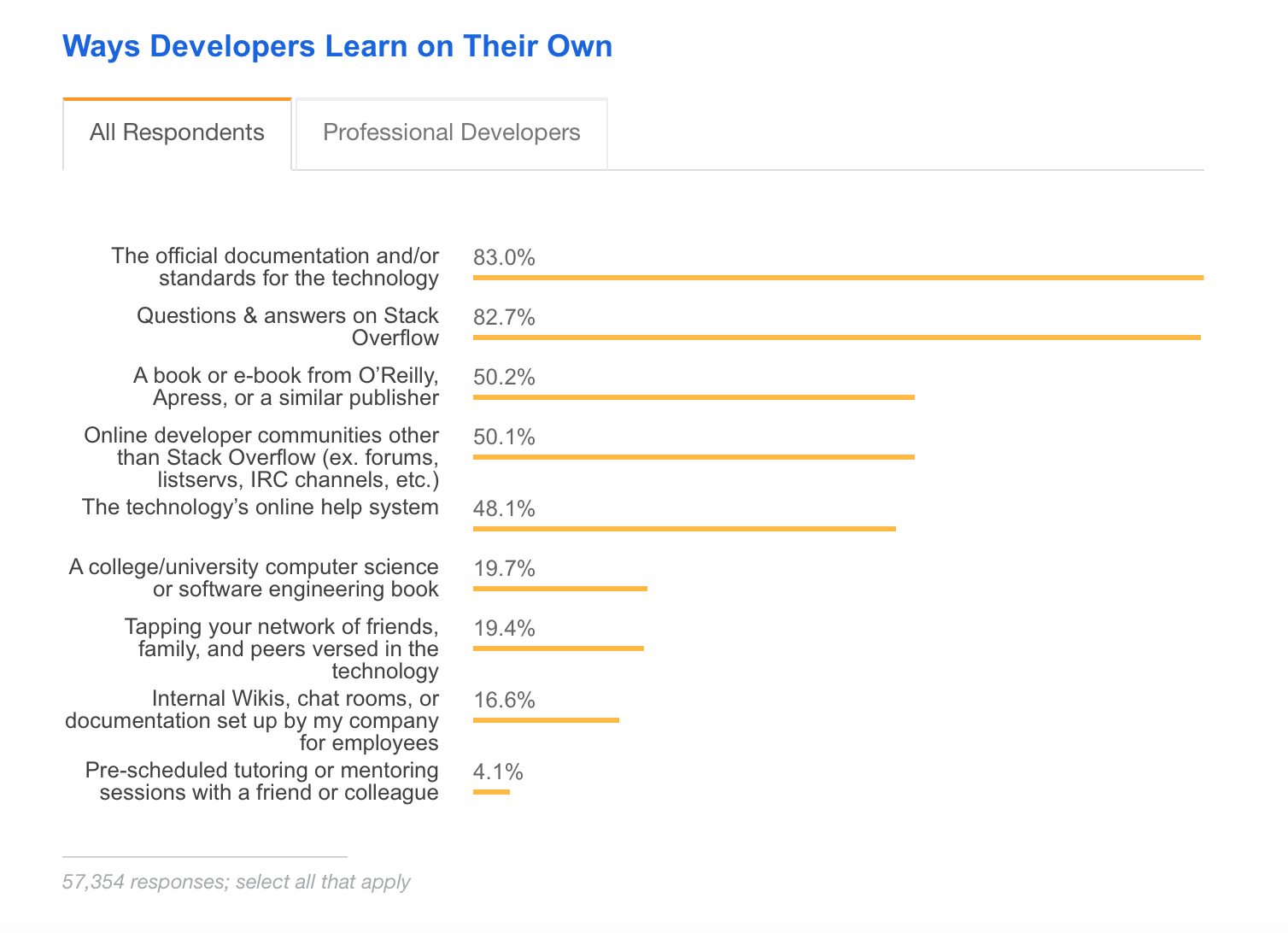
I suggest you review the entire report, but I’m going to pull out three screenshots that I will most definitely reference when I return to school after Spring Break.  They provide answers to three Computer Science related FAQs that I hear from students and parents: How can I learn how to code?  How can I get started as a software developer? How can I find my way in the Computer Science field?

# 1

Screen Shot 2018-03-13 at 10.59.19 AM.png

SO’s analysis of the above: “Developers are lifelong learners; almost 90% of all developers say they have taught themselves a new language, framework, or tool outside of their formal education. Among professional developers, almost half say they have taken an online course like a MOOC, and about a quarter have participated in a hackathon.”

# 2

Screen Shot 2018-03-13 at 11.07.42 AM

SO’s analysis of the above: “Over 80% of respondents rely on Stack Overflow Q&A when learning something new. Additionally, developers understand the value of good documentation, as over 80% also use documentation as a resource when learning.”

# 3

Screen Shot 2018-03-13 at 11.12.17 AM

My analysis of all of the above: The path forward as a developer is pretty clear, but it doesn’t always involve formal classes in school.  It seems to involve curiosity, tenacity, a self starting proclivity, and a willingness to engage with communities like the ones advertised in the Stack Overflow survey results.

Management vs. Leadership

Here’s a a cliche busting thought worth noting from page 28 of Joseph L. Badaracco’s Managing in the Gray.

One of today’s reigning cliches [in business circles] puts the stereotype succinctly: leaders do the right things, and mangers do things in the right way.

This cliche is badly misleading.  It ignores the fact that the great leaders of history were often effective managers who got the process right. We remember Mohandas Gandhi, Martin Luther King Jr., and Nelson Mandela for their galvanizing speeches, heroic self-sacrifice, and the millions of people they inspired.  But serious biographies of great leaders show they understood the importance of process.  In meeting after meeting, over months and years, they poured time and energy into managing the movements and organizations that amplified their impact on the world.

For example, we might have never heard King’s “I Have a Dream” speech if he hadn’t spent weeks beforehand forging a coalition of six fractious civil rights groups and organizing what became the March on Washington.

Undoing by Replacing

There’s a great Theodore Roethke poem, called “The Waking,” that houses and repeats this line: “I learn by going where I have to go.”

I’ve written often on this blog about my own learning and how it is frequently driven by a network imperative — “going where I have to go” — followed by conscious synthesis of Internet ephemera into relevant and meaningful knowledge for my work.

Today’s version of the above started with this Dan Pink tweet:

When I followed the link, I “met” rocket scientist Ozan Varol, who encourages us parents to undo, by replacing, some of our standard questions and prompts.  Here are my favorites:

“What did you learn today?” vs. “What did you disagree with today?”

“What did you accomplish this week?” vs. “What did you fail at this week?”

“Here’s how you do that.” vs. “How would you solve this problem?”

“You can’t do that.” vs. “What would it take to do that?”

“Did you make a new friend today?” vs. “How did you help someone today?”

Here’s the link to the full post and Varol’s admission that the post is, in itself, a trojan horse.

I learn by clicking where I have to click.

Starting from Seed: Crafting One-of-a-Kind, One-at-a-Time Experiences with Chef Tim Kuklinski

d19d5sz0wkl0lu.cloudfront.jpg

Reshan Richards and I eat in a lot of interesting restaurants when we travel for speaking engagements. During these experiences, we always toggle between pure enjoyment of the food and a larger meta-analysis of how the food experience unfolds. We’ve learned that great restaurants, whether they are expensive or bargains, sumptuous or bare bones, do what all great organizations do — they find a way to constantly renew and reinvent themselves while staying true to their core mission. They constantly learn, and their learning is on display each night.

Also, in a world where so many of our human interactions are filtered through digital channels, there’s something special about the fact that a restaurant experience is only possible because a group of people choose to convene face-to-face. The experience is shaped by the staff, who are hopefully passionate about their ingredients and what they are serving, and by the people who show up in the restaurant, the patrons. What the latter bring with them by way of curiosity, questions, energy, and conversation is nearly as important as the food and the ambiance.

In Denver for a leadership retreat last August, we ate at Rioja on Larimer street.  We didn’t have a reservation at Rioja, but luckily there were two seats left . . . by a bar looking directly into the kitchen. So, we had the unique pleasure of being a foot away from a chef named Mason and having the chance to ask him questions throughout the night. Mason, while continuously preparing meals right in front of us, kept up a lively banter amidst the hundred details that keep a restaurant humming along.

At one point, he told us, “this next dish requires 75 touches.” And that’s when we really started paying attention to the moves and mechanics of this restaurant. For each course, a waiter checked in with us immediately after we took our first bites. First our appetizers, then our meals, then our desserts, as if to punctuate our experience with their attention. Everything seemed so thoughtful and deliberate.

We reached out to Rioja’s Chef de Cuisine Tim Kuklinski because we wanted to get under the hood a little bit. We were interested in his thoughts on training, on remaining creative and vibrant in a city that seems to be filled with creative and vibrant people, how one establishes metrics like the “75 touches,” and so on. Here’s a synopsis, lightly edited for clarity, of what we learned.

Photo credit: Jennifer Olson courtesy of the Imbergamo Group