
From Fast Company.
Uncategorized
Leadership Card Game
My son has spent some of his downtime this summer trying to invent new card games. It’s one of the toughest challenges with which I have seen him grapple, since many invented games are either “all luck” or “too technical,” either “too simple” or “too complex.” Also, adding to the challenge, many games are shaped and adjusted over time by generations of anonymous players. Just try playing rummy with someone else’s grandmother — house rules shift from house to house. As we have found, not having the benefit of generations, of a crowd source, leaves many games feeling awkwardly amateurish and unfinished.
Regardless, as I was prepping for a leadership retreat, I decided to try to invent a leadership card game. I played it with a leadership team today, and it seemed to go pretty well. Maybe you can try it too, adjusting it where you see fit. Here are my rules:
A. Make a card for each of your team members. Yes, draw a picture of each member of your team. (I provided index cards and pens.)
B. On the back of each card, add each person’s vital statistics and superpowers. What do they do, day-to-day, for the institution, and what is their special talent?
C. In a small group, answer the following questions using the cards, making action notes on the cards where appropriate and sharing what you think you can.
- Which people have the chance to use their superpowers at work and receive praise for them?
- Which do not have the chance to use their superpowers at work and receive praise for them?
- Which of your team members are ready for more responsibility? What challenges and opportunities might you offer them?
- Which team member is your number 2?
- Which team members are the future of your discipline? When do they have the chance to express or share this?
- Which team members can you macro-manage without a problem?
- Which team members need more attention / active management, and how do you handle that without causing tension?
- Which team members have some characteristics / habits / mindsets / skills that you would like to spread among your team? What are those c, h, ms?
- Who is dealing with some personal stuff and may need some extra support?
- Which team members could be future leaders at this institution?
Mobile v. Mobile
Reshan Richards and I have been having an interesting conversation lately. As is typical for us, it’s unfolding over the phone, via text, on Zoom, and sometimes while cramming noodles into our mouths.
To boil it down, we’ve been exploring the virtues of having mobility (like a mobile phone or other technology) vs. being mobile (moving your body, with its senses, around your town, your state, your country, or your world).
The former — mobile technology — allows you to search for what you are looking for; the latter — your own mobility, to whatever extent that exists — allows you to put yourself in a place to discover things.
When I start teaching my English class in a few weeks, I’m going to keep these ideas in play. When do I want students to use mobile technology, when do I want them to use their own mobility, and what are the affordances and limitations of each when we are attempting to learn and do what we set out to learn and do?
Question + Nudge
This short post contains a great question and a healthy nudge.
First the question, which I’ve adapted into a stem:
What is offline ______ experience better than online______ experience at achieving?
Or, flipped:
What is online ______ experience better than offline______ experience at achieving?
(The post inserts the word “retail” to ask the question, “What is offline retail experience better than online retail experience at achieving?” I’d imagine you could have a good discussion if you inserted the word “educational” or “communication” or “training” or “entertainment” or “social.”)
And here’s the nudge:
Designers . . . have cultural antennae and cilia that are tuned by far-field signals that are hard to leverage when imprisoned on the other side of the glass display of a smartphone. Digital omniscience is cool — no doubt about it — but the algorithms that are used to fetch for us “interesting things” lack a bit of multi-dimensional randomness that the real world can often bring us.
New term (for me)
Technical debt is also known as design debt or code debt. It is “a concept in software development that reflects the implied cost of additional rework caused by choosing an easy solution now instead of using a better approach that would take longer.”
Futterman’s Rule
“When two are served, you may begin to eat.”
Here’s a longer explanation from Nathan Brackett:
The elegance of Futterman’s Rule does lend it a hint of spirituality. One eats one’s food while it is hot, observing dinner as a natural continuum (instead of the top-down, “no-one-eats-until-the-chef-is-ready” hierarchical model that dominates most households). At the same time, no one eats alone (it is only once two people are served, and a social base is established for those with food, that one may begin to eat). If form follows function, the Rule is built to travel. So give it a try. And if you like it, tell a friend.
Notes
Notes from a recent keynote presentation I gave (via @MeaningfulMindx, who shared them, from @DanaBettinger, who sketched them).
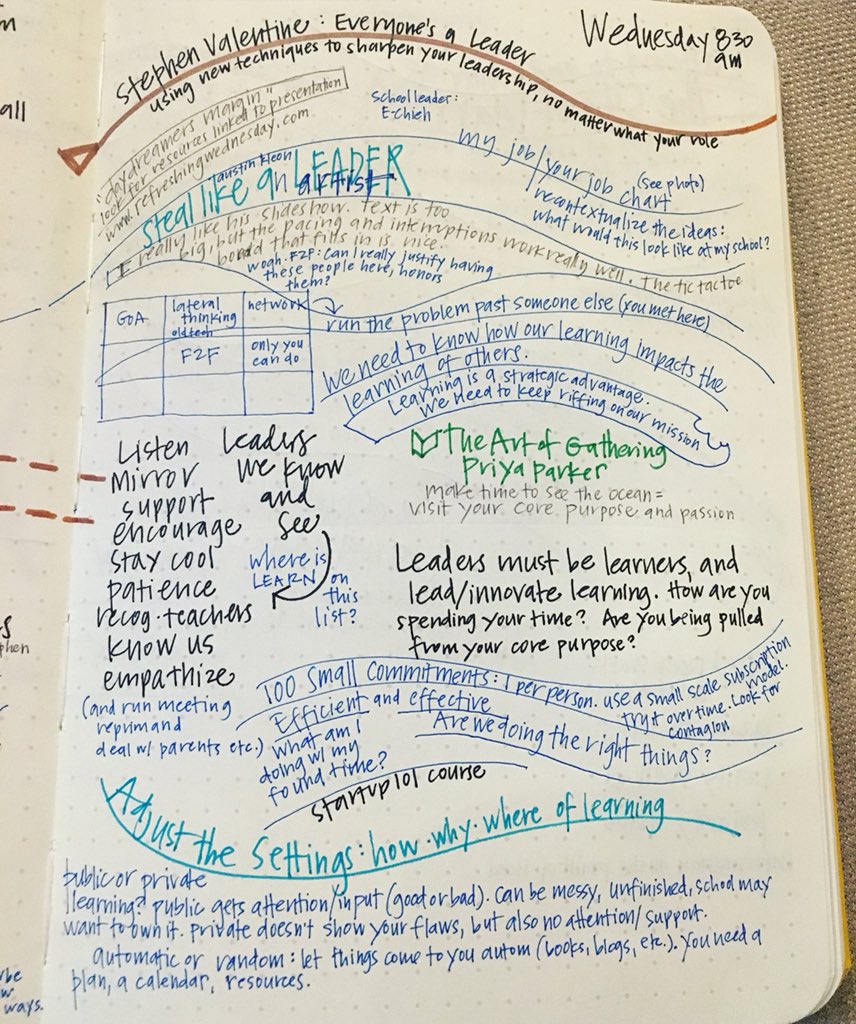
GOA Parallel Presentation
[For participants at GOA Learning Design Summit who will be attending my keynote: I hope you will learn from my slides, from my commentary, from each other, or from the links below (they complement my presentation). I’m going to rely on you to go where you need to go to learn as much as you can during the 90 minutes we spend together.]
First read this. It’s about something I call the Google Quotient, and it will help you to make the most of my presentation.
The invention of the AeroPress coffee making device. Quick synopsis from the article: “This is the story of how Adler and Aerobie dispelled the notion of industry-specific limitations and found immense success in two disparate industries: toys and coffee.”
Some background on the Fosbury Flop.
“Steal like a leader” comes from Steal Like an Artist. In my opinion, Kleon’s blog and Twitter feed are their own genre . . . the micro-MFA in Creativity.
The Wikipedia page of Japanese video game designer, Gunpei Yokoi. It mentions his philosophy, one of the great titles of any philosophy: “Lateral Thinking with Withered Technology” or “Lateral Thinking with Seasoned Technology.”
NYT interview with the author of The Art of Gathering.
Unsplash, the great photo site.
Startup 101: A Reshan Richards x Montclair Kimberley Academy collaboration.
Telly Olsen’s May Term interview with freeform radio legend Vin Scelsa.
Experts on the future of work and job training. Where I found the Litto quote.
Montclair Kimberley Academy’s May Term program.
My most popular blog post of all time — on moving people to Bcc: as a form of leadership and manners.
The great Calendar Automator.
Outstanding article about the shift to longer classes at Montclair Kimberley Academy. If you’re considering this move, reach out to the author of the article.
Scroll down to # 4 to see a full articulation of meeting terminology.
Manager’s Schedule vs. Maker’s Schedule. A classic.
Quick (and not so quick) look at SAMR.
Polarity (and its maps) explained.
Information at the point of need. Scroll down to the examples.
Closing survey: https://goo.gl/forms/gkXor16dUeLkaPTp1
Bonus: A letter my daughter packed in my suitcase and instructed me to open right before today’s presentation: “We could never be unconnected.”

Worth Noting
Here’s Aaron Dessner describing, via press release, the process that led to his new album with Justin Vernon.
I don’t think the record would exist without the community that came together to make it. . . . We took the music to a certain point, and then we reached out and sent it far and wide, inviting friends to contribute any and all ideas. We’ve viewed the record and the process from a community standpoint. We’re incredibly excited about it, as excited as we would be for any album we might make in another situation that’s more conventional. But this feels like something new—the process felt different and the outcome felt different. [source: Pitchfork]
File under: New model for working / art-making.
Marginal Grib
Ryan Holiday has got me hooked on a new daily read — Marginal Revolution, the blog of Tyler Cowen and Alex Tabarrok, both of whom teach at George Mason University.*
I’m sending this post about “grib” to my writing partner, Reshan Richards, since we love simple, low-tech collaborative tools. I like both the concept (grib as bookmark) and the final admission (“I do recognize that the productivity gain here is small. And much of that gain simply may come from the feeling that ‘I have a system’ rather than from the properties of the system itself.”) Pragmatic, honest stuff.
*I now read 3 blogs everyday: Fred Wilson’s, Seth Godin’s, and Tyler Cowen’s / Alex Tabarrok’s.
 Refreshing Wednesday, LLC