

Uncategorized
Working in Public
One of the benefits of working in public semi-regularly, and being open about the fact that I enjoy learning as much as I enjoy teaching, is that I tend to receive feedback in a fairly regular drip. (Not a lot, but steady.)
An example… I recently tweeted about a program I’m running at school. I tweeted 8 times in a row with a similar sentence stem, hoping to share some information with my followers. A former student — who works in marketing and has a native understanding of social media — direct messaged me almost immediately. For similar missives in the future, he encouraged me, “use a threaded tweet approach.” As he said, “8 similar tweets scan as 8 of the same tweets; people think it’s a mistake, move on, and entirely miss the point of the communication. There’s a better way.”
Feedback is gift that is often withheld. (To test that theory, think about all that you know about the people with whom you work and all that you’ve actually shared with the people with whom you work.)
I’m lucky to have a small audience — built by working in public and making my values known — that takes the time to tell me when and how I can do better.
Less More
From “A Reggae Heart Beating in the Bronx” by Brandon Wilner, as seen in The New York Times, January 6, 2020 edition.
In 1976 [legendary Reggae producer Lloyd] Barnes set up shop at 4781 White Plains Road in the Bronx, where his studio had an adjoining record shop called Wackie’s House of Music. At the time he worked in construction, and spent his earnings on equipment from the Sam Ash music store on West 48th Street in Manhattan. Financial constraints led to technological ones, which required resourcefulness in his recording strategies. The result was a rich and textured sound that gave his studio’s music an audible signature, which in reggae and dub caries just as much weight as the songwriting; the studio itself is considered an instrument.”
Link to article.
Useful-Skeptical Filter of the Day
These sentences, from today’s Why is this interesting?, feel solid and sound to me — a useful-skeptical filter to apply to the world.
We are more spoilt for choice than ever before. Yet the places where you can go for a trusted review are fewer and fewer. Not as many editorial publications spend the time and rigor to put things through their paces, instead relying heavily on the PR narrative and a quick kick of the tires.
Discussion Feedback: The Strategic Pause
I was reminded yesterday of the power of making the invisible visible . . . or providing new views of routine behaviors. Though this diagram is messy, it helped me to show my class the pattern of one of our discussions.
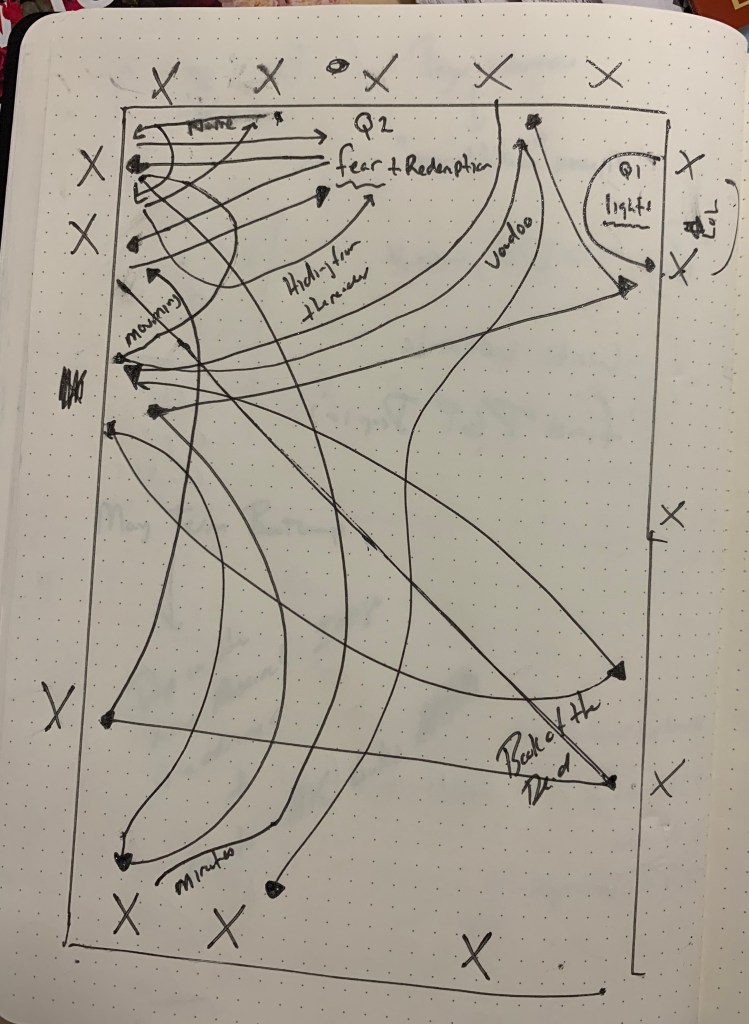
About halfway through, when the diagram was half complete, I took a strategic pause, stopped the conversation, and showed the diagram to the students. Several students who had not participated at that point showed up with renewed vigor after they did not see arrows coming from their names. They wanted to show up in the diagram.
I like using diagram sketches mid-conversation to offer feedback to a discussion-in-progress. It works. Next time, with this particular group, I’m planning to write TE on lines to indicate when a student uses actual textual evidence to support a point. After that, I’ll notate for gender, comment type, and other items that will allow me to show students, with great clarity, what I truly value as a discussion leader.
You can always teach with more precision.
The 3 Levels of Employees
Here’s a Tweet from Atomic Habits author James Clear. It’s the kind of thing I plan on sharing, in some form, with new employees at my school and with the people charged with helping to develop those new employees. It’s quite simply a path to leadership with an entrepreneurial bias — moving from being what is sometimes referred to as an “individual contributor” to a systems thinker/doer to a future-oriented institutional leader. Not everyone needs or wants to follow this path, but it’s certainly a fulfilling, interesting, and challenging one. Also, I believe it unfolds in the right order and that patient movement from level to level is best for one’s career growth and trajectory.
May Term
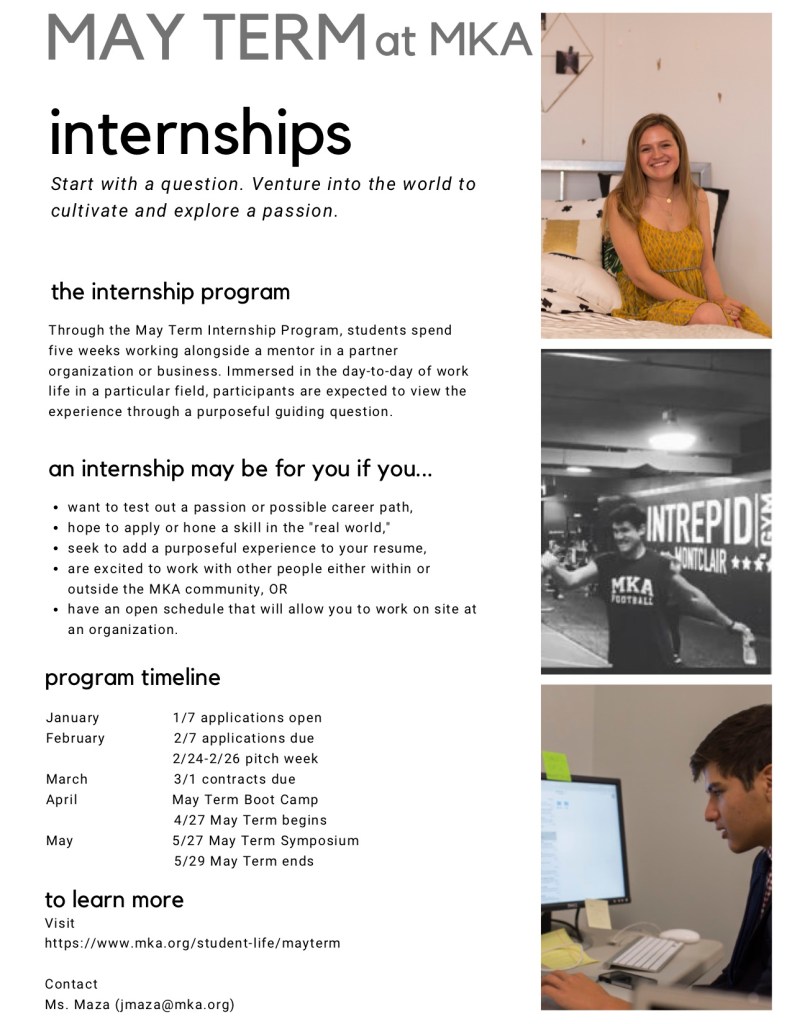
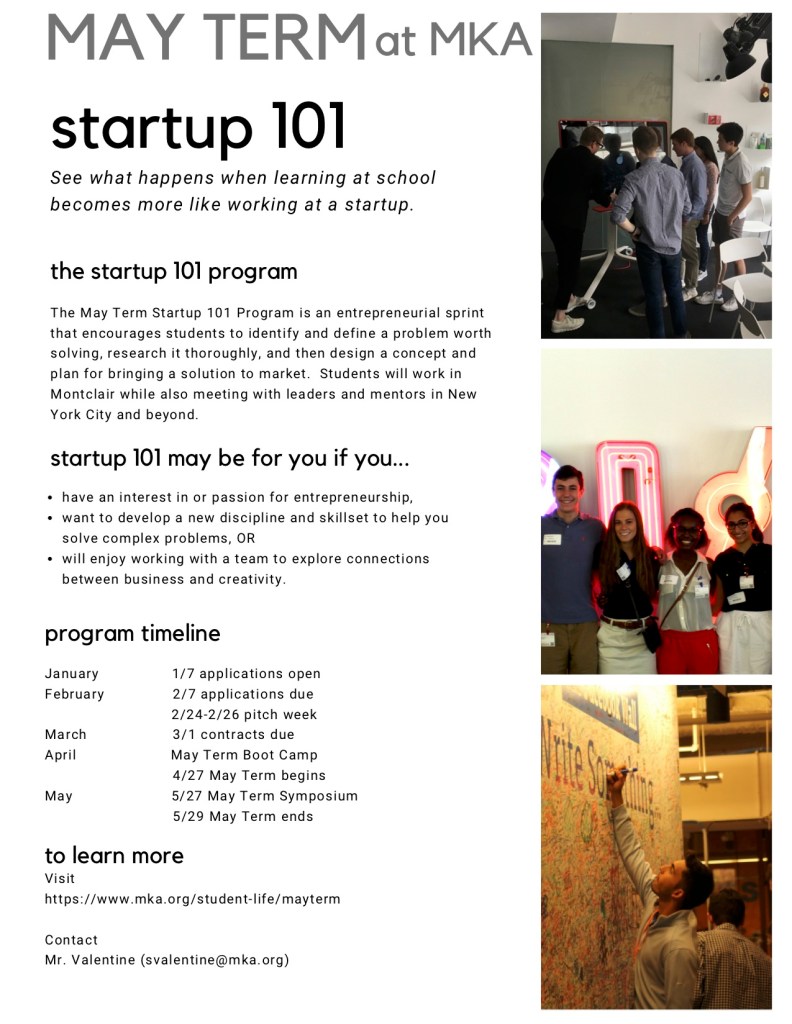
Though it’s only January, the seniors at my school have begun to plan their May Term experiences. Here are some posters that advertise the various opportunities / learning platforms available to students.




A Series of False Dichotomies
Lately I’ve been chewing on the book In Search of Deeper Learning: The Quest to Remake the American High School (Mehta and Fine). In particular, I’m engaging with its premise that, at times, the deepest learning in high school happens “at the margins,” or in activities that can be classified as extracurricular or co-curricular.
More on all of that later, but here’s a nice quotation about — and therefore from — the bottomless fount known as John Dewey:
Dewey . . . rejected what he saw as a series of false dichotomies: between the practical and the academic, between school and society, between the interest of the child and the centrality of the subject. Dewey argued that all of these seeming gaps could be fused by skilled teachers: for instance, understanding how a car works can and should be integrated with understanding physics and chemistry. He also maintained that it is worthwhile for all students — no matter their eventual destinations — to understand both the practical mechanics of the car and the underlying scientific disciplines. Dewey was horrified by both the stilted teaching that to him produced superficial understanding in formal schooling and the bastardization of his ideas by progressives who emphasized the practical to the neglect of the academic.
More assertion that in the poker game of education, both . . . and beats either . . . or.
The Impeded Stream
I liked this article by Morgan Housel in part because it reminded me that song and story can be deceptive. Of course I should have learned this lesson from the forethought of Odysseus, who chained himself to the mast of his ship and packed his ears with beeswax so as not to be seduced by the song of the sirens as he sailed past them. But I didn’t. Or rather, I learned that lesson and then forgot it a hundred times. Here’s how Housel puts it, reteaching me:
Good storytellers with OK ideas are more persuasive than average people with the right answers. This is obvious because everyone knows how much money and effort goes into marketing. But then it also should be obvious that there are many people with useful information and great ideas who aren’t natural marketers. We ignore these people, which is a shame. There is no chance that the best marketers, the best speakers, and the best writers always have the best ideas. But that’s easy to overlook because good communication is seductive.
The other lesson here is the inverse of Housel’s rule. Don’t give too much credence to good storytellers and marketers just because they communicate cleanly and smoothly; equally, learn to sit with, and seek guidance from, the inarticulate, the blocked, the un-smooth, the one who is not slick or charming, the gruff, the silent, the introspective, the bruised or bruising, the awkward, the bumpy, the unstudied, the understudy, the voice-cracked, the cracked, the off-putting, the stumbling, the shuffling, the burdened, or the blaspheming. And why? Because, as Wendell Berry once said, “the impeded stream is the one that sings.” You have to widen your definition of singing, that’s all.
Idle is a Verb
Here’s a slide from a webinar Reshan and I recently delivered for Columbia’s Teacher’s College. I’m posting it in honor of the (almost) holiday break that many of us will be enjoying soon, I hope. The quotation* is chewy but rewards effortful reading.

*Source: “Rest Is Not Idleness: Implications of the Brain’s Default Mode for Human Development and Education” with H/T to Scott Barry Kaufman.
 Refreshing Wednesday, LLC