
The Blending Leadership Newsletter will ship tomorrow at 10 a.m. The best thing we uncovered while researching it was a short word — FIKA — with a long tradition. Here’s an article (that didn’t make the newsletter) about this very nice Swedish tradition.
Working Definition
Prepping for a keynote presentation, I decided to try to really refine my definition of “thought leadership.” This term is often derided — for good reasons — but I see it as a central component of leading in a world marked by mobility (you don’t have to work where you live), networks (you’re changed by connection, whether you like it or not), and near constant change and upheaval (too many examples to mention). So here’s my latest working definition:
Thought leadership is a practice wherein you create a consistent, public (greater than 1) breadcrumb trail of inquiry, discovery, enthusiasm, generosity, and gratitude. In a world that is as networked — and changes as constantly — as ours, leaders are those people who can lead by learning and learn by leading. Thought leadership is a need-to-have, not a nice-to-have, an essential component of leadership, not a side effect, alternate route, or escape plan. Done well, thought leadership doesn’t lead you away from your work, but deeper into it, drawing others closer to it as well. It amplifies, connects, accelerates, and prods, flooding existing systems with new ideas.
We all know that email is a burden for everyone. One of its best features — enabling asynchronous communication — is also its chief bug, i.e., whenever you’re not using email, someone is leaving you work to do in your inbox. Take a break and you fall behind; fall behind and you can’t take breaks.
But last night, I made a decision to clear out some space in my calendar, stay up a little bit later than usual, and really work hard in my inbox. I communicated as clearly, directly, and energetically as I could. I picked up old threads. I started some new conversations. I invited some people into, or back into, my workflow. I sent out thank yous and provocations and improvisations. I closed some loops that desperately needed closing and opened a few that needed opening. In short, I tried to make email feel artful and personal again. Vital again.
And today, as people responded to last night’s flood of emails, I felt truly energized every time I looked at my inbox. The energy, inquisitiveness, and creativity of the emails I received matched the energy, inquisitiveness, and creativity of the emails I had sent. Being in email felt like being in really good conversations. It felt human. The game itself didn’t change, but for an evening and a day, the players did.
A Series of Fortunate Events
Last night, I accidentally left my car parked on the street. When I realized this in the morning, I was instantly frustrated. I have some reasons — none of them positive — for wanting to park my car close to, or in, my garage. I sent my daughter out to get into the car, picked up my bag, walked out behind her, and found her standing in front of the car, her mouth literally agape. She was staring at the park at the end of the road, a view she never sees because we usually pull out from the garage and drive in the opposite direction. “Look at the beautiful, glorious fog!” she said, a bit too loud. “I’m never not coming out here again in the morning!”
She was right. The fog was exquisite, hanging above the earth like spools of thin silver twine kicking off sunlight. But we had to get to school, so we quickly drove away.
After drop off, I ran smack into another problem. A road closure had diverted traffic, so it took me twenty minutes to travel 1.5 miles from my daughter’s school to mine. Since I arrived late, I wasn’t able to complete the one task that I needed to complete before 8 a.m. I was supposed to return proofread comments (which we send home to parents) to teachers’ mailboxes.
Knowing I was late, I decided to walk around the building and hand each teacher his / her proofread comments. This only amounted to twelve teachers, but on my trip around the building, which was frustrating at first and certainly not my normal routine, I noticed something interesting in almost every quiet corner of the school: the human equivalent of exquisite fog, hanging above the earth like spools of thin silver twine kicking off sunlight.
Color Blind Friendly Mode
Working in Trello last Friday (it’s part of my standard Friday workday), I noticed a new feature in the labels section. Look at the bottom right of this screenshot:

When I enable “color blind friendly mode,” I see this:

There are always new ways to serve the people that you serve, new ways for your organization to live out its mission and values. What’s your company’s / school’s version of color blind friendly mode?
“How You Worry is Critical”
Deepen the Learning
Slides from tonight’s Back-to-School-Night presentation…


[In the Interruption]
I had an ambitious agenda planned for myself today, and here’s how things played out:
First hour of the workday
- Plan: To grade a stack of quizzes and plan a class.
- Reality: On my way into school, a panicked teacher asked me if I could stop by his class to provide “real world” feedback for a group presentation. His expected guest didn’t work out, so he needed a quick replacement. I graded and planned for 25% of the time I had set aside for the task and then went to the class to provide feedback. [In the class, I met some amazing 9th graders; I also had a chance to briefly discuss queuing theory with the teacher — not a conversation I have every day — since it might be useful to the students’ project.]
Second hour of the workday
- Plan: To meet with a colleague.
- Reality: We started the meeting a few minutes late (thanks to the fact that I was observing the class above), and we were interrupted by a fire drill. [During the fire drill, I bumped into a colleague who is beginning her leadership path. We walked back into the building together and had a chance to have a quick, reflective discussion about a recent experience that she had. I felt like I was able to provide some support to her at a time when she might have needed it.]
Third hour of the workday
- Plan: To meet with a student to discuss sketch-noting.
- Reality: We had this meeting, and in the middle of it, I pulled in another administrator who I thought could help this student develop a role as our school’s Sketchnoter-in-Residence. I literally asked the student to “pitch” her idea to the administrator, and the administrator not only listened to, but also strengthened the proposition. [This was a completely improvised outcome — not what I expected at the start of the meeting. After the student left, I continued talking with my colleague for a long time. We discussed media platforms, writing, and how she might be able to use her interests to connect with educators outside of our school. We had vaguely planned to have this discussion, and it fit in perfectly after our conversation with the previously mentioned student, so we went with it.]
At 5:15, I looked at my schedule and was about to put my head down to try to finish off a few more planned tasks. But then I hesitated and thought about my day. The pattern above continued off and on from 11 – 5. In the moment, getting knocked off task had been frustrating, but in retrospect, I realized that I did my best work in the interruptions, in the unplanned territory. I immediately got up, packed up, went home, fired up the barbecue grill, and invited my family to a completely different kind of weekday dinner. Why?
Because the unplanned part of my day had been so rich, so filled with surprises and good connections, that I decided to let that part win. Not surprisingly, I did my best work — this time, as a husband and a father — there, in the interruption. [ ]
Automated Humanity
This year, I’ve been using youcanbook.me. One of the things I like best about the service, which I pay for, is the ways in which you can customize and personalize it. It automates part of your life — the back and forth involved in scheduling meetings — but the automation can increase the humanity of the tail end of the exchange if it is used properly.
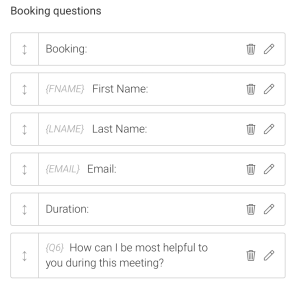
Q6 above is one that I wrote and added myself. It appears after a person has nearly completed booking a meeting with me. I like the fact that it forces the person to focus on a clear outcome for the meeting. I also like the fact that it helps me to prepare, in advance of the meeting, to best serve the person with whom I will meet. A thoughtful answer to the question helps the person calling the meeting and the person called to the meeting; it provides a little nudge to help us both make the most of our face-to-face time together.
Here’s an answer I received in advance of a meeting I’m having tomorrow.
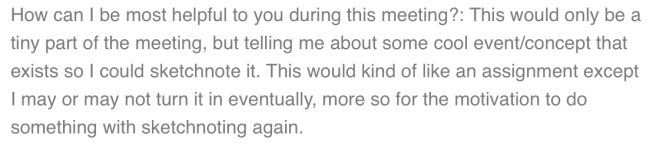 The assignment was completely unexpected, but its specificity has inspired me to pull a few books off my shelf and look up a few resources. When the meeting starts, we’ll be five steps ahead — ready to dive into things that truly matter to this particular person.
IQ, EQ, GQ
There’s IQ, EQ, and now GQ.
GQ is something I made up*, but I think it’s worth keeping in mind when you give presentations or work with students (or anyone you are trying to teach). It means Google Quotient (like IQ means Intelligence Quotient and EQ means Emotional Quotient).
If you succeed in a presentation, you will not only transfer information or enthusiasm to your audience; you will also implant questions or bits of half-remembered concepts that people will be able to look up (i.e., “Google”) when they are back at work.
So, for example, if you’re presenting to a group and you show them how to assign comments in a Google Doc, they don’t have to remember every single step. As long as they remember that such a move — assigning comments — is possible, they will be able to follow the Google breadcrumb trail and figure out how to achieve their goal.
When you make presentations, remind people that they don’t have to remember everything you tell them or show them. All they have to do is remember what to look up, what to Google, and they will have derived some benefit from spending time with you.
*I made up GQ today in that I coined the phrase. I observed it in the wild the last time I watched Reshan Richards present. I don’t remember everything he showed me, but I remember something about everything he showed me. I can use that something to access more detail, via Google, whenever I need to.
 Refreshing Wednesday, LLC