Writing Marathons

One of the great writing teachers at my school (Cindy Darling) takes her students on an annual “writing marathon.”  She has done this for the past few years, and each year the experience gets a little bit bigger and the group travels a little bit further.  But a few things always stay the same, according to Cindy’s guidelines.

  • Writers begin a marathon by turning to each other and saying, “I’m a writer.”
  • We split into our class groups to go to restaurants, coffeehouses, parks, etc., where we eat, write, and share our way across the city.
  • Our writing starts on the train on the way into the city.
  • We follow basic rules: allow about ten-twenty minutes of uninterrupted free-writing time. Each group member then shares. We limit responses to a simple “Thank you” after each student’s share.
  • A connection and synergy develops in each group as participants see that the writing they generate throughout the marathon springs organically from the place around them. Some writing also contains the seeds for future revision.
  • Groups find their own path. Students will visit 3-4 different locations in NYC over the course of the morning.

Boiled down, this experience offers students choice, autonomy, the opportunity to share, the opportunity to learn from their peers, self-directed learning, community, a chance to slow down, a chance to appreciate a local environment, generative practice, and maybe best of all, a model for the creative life.  It’s the kind of event that reminds me about the transformative power of school, properly administered.

Getting a Gig at CBGB

In last Sunday’s New York Times Magazine, Kim Gordon, from the band Sonic Youth, talked about what her life was like before her band became famous and wildly influential.

Our first goal [as Sonic Youth] was getting a gig at CBGB. Then it was getting a good time slot at CBGB, so you weren’t on last and weren’t on first. CB’s wasn’t the best sound; it was such a long and narrow space that if it was crowded you couldn’t really see anything, unless you were standing on the side of the stage, and then you just heard the stage sound. Sometimes it could just be too blasting. It wasn’t actually the best place to hear or see bands, but it was always exciting. Then later, it became about getting a gig at Danceteria, Mudd Club — they were all little milestone achievements.

What I think is worth noting about this quote is the way it concretizes, rather than romanticizes, the path to progress and ultimately success.  Sonic Youth has had a deep and lasting impact on modern music, and Kim Gordon has become a cultural icon.  These are outstanding achievements, for sure, and the band and Ms. Gordon may have been dreaming about them all along.

But first they dreamed concretely and stepwise, which, in music, according to my Google dictionary, means “moving by adjacent scale steps rather than leaps.”

They had a concrete wish, a concrete plan, and once they achieved that step, they tried to take the next step after that.

Too often, we romanticize our objectives, blowing them up into identity boosters (I’m a writer, I’m a musician, I’m a teacher) instead of reducing them down to simple, effective behaviors  (I write 250 words each day, rain or shine, I practice my scales each day, rain or shine, etc.).

So, because I care about your work (or what’s a blog like this one for?) I’ll give you these simple, Kim Gordon inspired questions: What’s your version of getting a gig at CBGB?  What’s the next concrete step you need to take to get there?

85845473.jpgGetty Images

Unbundling?

Fortune recently put out its list of the “The World’s 50 Greatest Leaders.”  One common theme in these leaders’ behavior, according to the authors of the article, is that they have “[harnessed] the power of unbundling.”  Here’s an extended quotation about that term:

Unbundling means disaggregating enterprises of all kinds, from the smallest startups to entire nations. In business it can mean making a company more valuable by splitting it up, as Hewlett-Packard did and other companies (Honeywell, Pentair, DowDuPont) are doing. Or it can mean increasing value by delegating functions once regarded as necessary parts of the whole; Apple’s outsourcing of complex, high-tech manufacturing, and the staggering capital requirements that go with it, is a dramatic example.

Technology makes unbundling possible and often inevitable. For centuries, greater size made companies, nations, and other enterprises more efficient and effective. Increasingly, it doesn’t. Outsourcing and coordinating manufacturing, distribution, research, and nonemployee workers becomes easy and cheap in the digital era. The most extreme example is the Chinese appliance maker Haier, which is not so much a company as a platform that invites entrepreneurs to become one of thousands of microenterprises within its ecosystem. Crazy? Definitely not. Using this radically unbundled model, Haier has become the world’s largest appliance brand.

So now I’m thinking about what this would look like in schools . . . and if it’s right for us.

A Simple Hack for Writing a Book

Here’s a story someone told me about how Brian Koppelman, a relative unknown at the time, wrote the script for the movie Rounders.

Apparently, Koppelman decided that he really wanted to find a way to join two of his obsessions: screenplays and poker.  His answer was combinatory: he would write a screenplay about poker.

Once he made that decision, and after seeking his wife’s blessing, he came up with a plan.  He would rent a storage space below his apartment and meet his writing partner there for two hours every morning before work.  During these two hours, they would work, exclusively, on the script.

After writing, they would go to work and tackle the day’s challenges.  After work and some family time, they would research (in this case, that meant playing poker at tables around New York City).  During their research, they would notice and collect as many authentic details as possible.  Phrases, mannerisms, setting, slang, etc.

They developed an outline that could only be changed if a better idea came along.  And if that better idea came along, the outline would shift to allow for its inclusion.

They stuck to this schedule six days a week, taking off Sundays, until they accomplish their goal.

Once the script was finished, they worked to sell it, which also required tenacity and discipline and rejection and adjustment.

Let’s break down Koppelman’s story to derive some clear lessons:

  1. He started with serious passion — poker, writing — and decided that he wanted to pursue it.  (Without that initial decision, you’ll just be floating around or dedicating fits and spurts of energy to a project.  See also Austin Kleon’s banker’s box approach, which he borrowed from Twyla Tharp.)
  2. Next, Koppelman spoke to his family.  (In considering a big side project, it’s important to realize that it will most likely pull you away from you other responsibilities.  At home, in particular, it can make you less attentive, less present, less engaged.  It can cause you to be irritable.  And it’s best to be honest with your family, if you have one, about all of these side effects.  You should work hard up front to set out some lines of demarcation and to negotiate the demands on your — and their — time.)
  3. After squaring things with his wife, Koppelman found a barricade in which to write.  (While writing, this space allowed him to cut out all possible distractions and the temptation to deal with easier work or life’s urgencies.)
  4. He showed up at the barricade every day, at the same time, rain or shine.
  5. He kept his day job, allowing him to survive.  (This is the first rule of making art on the side — you have to survive.)
  6. He fed his side project with fertilizer from the outside world.  (His nightly research no doubt gave him the energy he needed to return to his morning writing with gusto.)
  7. He allowed his idea of the project — his outlines — to evolve.  (Stubbornness is fine, but it should be worn lightly in the arena of ideas.)
  8. After finishing his project, he shifted gears and figured out how to sell it. (When you finish a project, your work is not going to sell itself.  You’ll need just as much tenacity, and just as thorough of a plan, to sell it as to write it.)

So that’s it.  The simplest hack I know for writing a book is that there is no simple hack.  You didn’t think you were going to find something else here, did you?

A Third of the Time

In a recent article about leadership, wunderkind, pizza lover, and all around good guy Shane Snow included this parenthetical remark:

(As a good editor of mine once told me, great writing is about research, writing, and thinking. Most people forget to spend a third of their time on the latter.)

And, just like that, he utterly challenged the way I teach writing (something I’ve been doing for almost two decades).  It’s that last “third of the time” — thinking — that usually gets away from us.

Lending Privilege

I just read about Anjuan Simmons’ “lending privilege” concept.  It’s great, and senior leaders should (must) take note. Fortune reported on a presentation Simmons recently gave at Github Universe, breaking out some of his key concepts:  

  • Credibility lending . . . happens when you provide visibility for someone that helps draw positive attention to their work. [Simmons] uses the theatrical example of talk show host, Stephen Colbert, swapping seats to let activist DeRay McKesson sit behind his desk. But inviting someone to co-present an idea to the boss would also work, or acknowledging their contribution in an important meeting.”
  • Access lending . . . happens when you provide access to information, locations or experiences that can help someone else grow their knowledge, or get a better sense of how your company works. A good example is an invitation to an executive meeting or access to specialized research.”
  • Expertise lending . . . happens when you acknowledge someone else’s expertise by giving them an opportunity to shine, like taking the lead on one of your projects.”

Here’s a small nudge for senior leaders: ask everyone on your top leadership team to attempt one of the privilege lending techniques described above. Set a meeting as a deadline, and at that meeting, ask the leaders to share their example, how it went, what they learned from it, and perhaps most important, what their “guest” learned from it.

Leadership and (is) Communication and (is) Design

When asked by the NYT about what his focus on design has taught him about leadership, and whether or not good designers make good leaders, Scott Belsky said:

So much of leadership boils down to communication, and so much of communication boils down to design. I think most leaders overestimate the value of meetings and underestimate the value of visual aids to drive alignment. If a picture is worth a thousand words, a mockup or prototype is worth a thousand meetings. Leaders without a design background should recognize the value of partnering with designers rather than outsourcing to them. Having a designer at the table when solving product or communication challenges is a competitive advantage.

Stack Overflows with Answers

[This blog post is dedicated to Karl, Anthony, and Neil, in no particular order.]

Stack Overflow is a place where developers “learn, share their knowledge, and build their careers.”  Each year, they survey their community (the largest of its kind) to develop insights about everything from the dominant gender of the field (guess) to the ways in which developers use Stack Overflow itself.

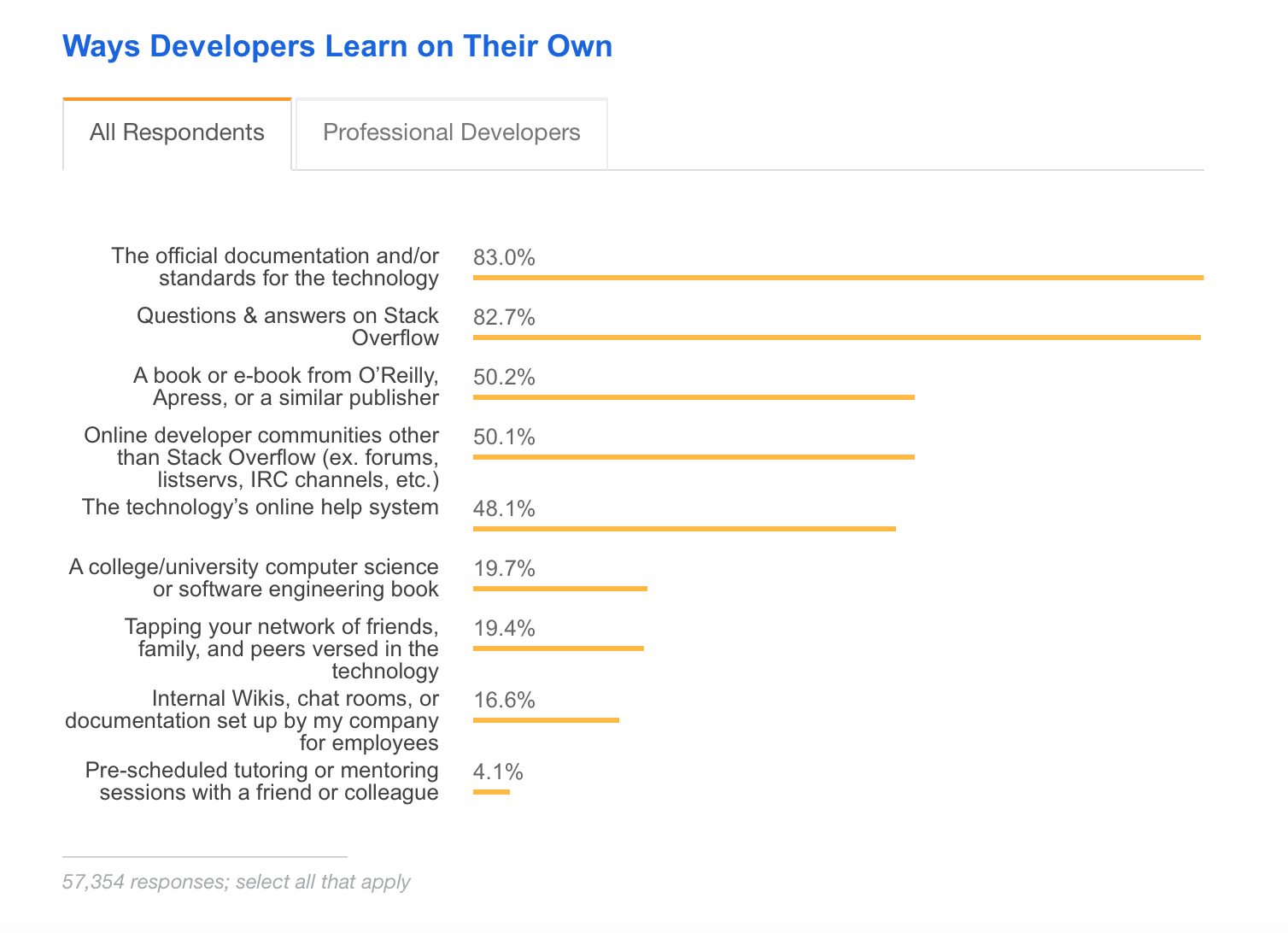
I suggest you review the entire report, but I’m going to pull out three screenshots that I will most definitely reference when I return to school after Spring Break.  They provide answers to three Computer Science related FAQs that I hear from students and parents: How can I learn how to code?  How can I get started as a software developer? How can I find my way in the Computer Science field?

# 1

Screen Shot 2018-03-13 at 10.59.19 AM.png

SO’s analysis of the above: “Developers are lifelong learners; almost 90% of all developers say they have taught themselves a new language, framework, or tool outside of their formal education. Among professional developers, almost half say they have taken an online course like a MOOC, and about a quarter have participated in a hackathon.”

# 2

Screen Shot 2018-03-13 at 11.07.42 AM

SO’s analysis of the above: “Over 80% of respondents rely on Stack Overflow Q&A when learning something new. Additionally, developers understand the value of good documentation, as over 80% also use documentation as a resource when learning.”

# 3

Screen Shot 2018-03-13 at 11.12.17 AM

My analysis of all of the above: The path forward as a developer is pretty clear, but it doesn’t always involve formal classes in school.  It seems to involve curiosity, tenacity, a self starting proclivity, and a willingness to engage with communities like the ones advertised in the Stack Overflow survey results.