
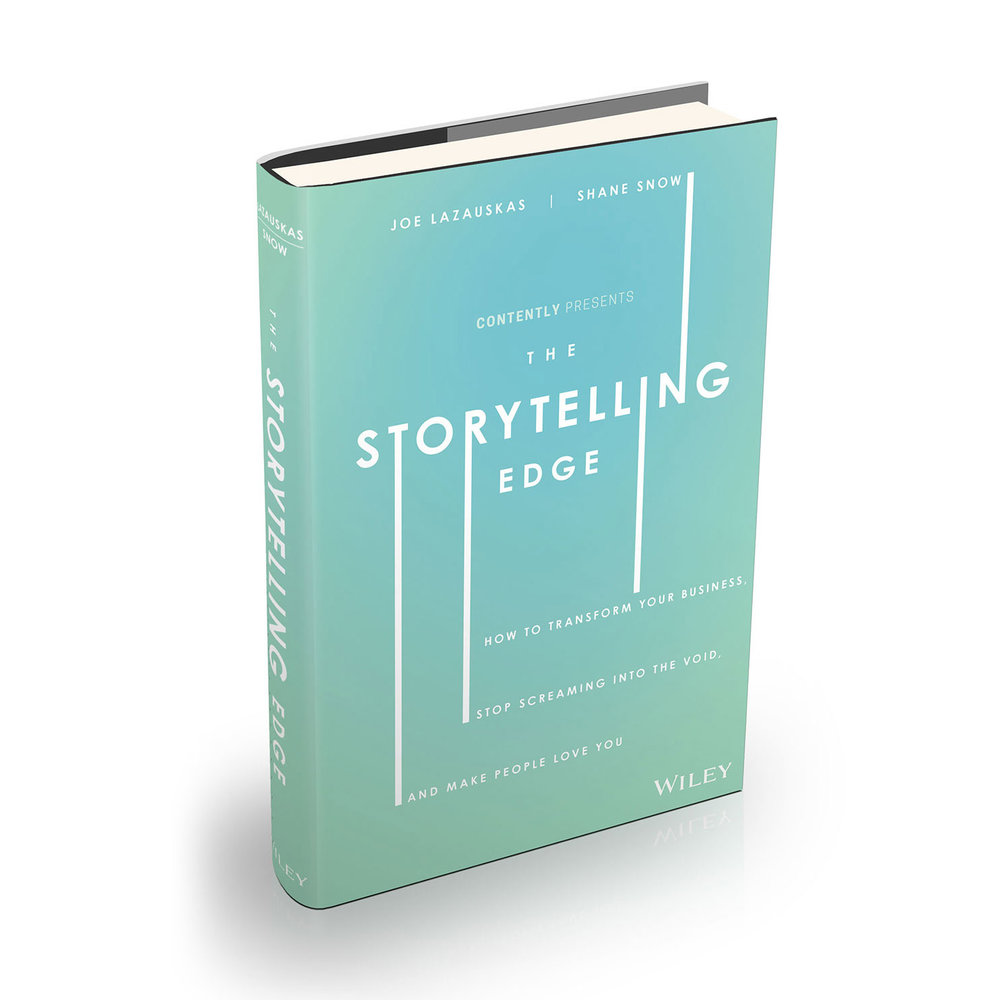
Recently, Reshan and I sat down with Shane Snow and Joe Lazauskas to talk about their new book, The Storytelling Edge: How to Transform Your Business, Stop Screaming Into the Void, and Make People Love You (Wiley 2018). We see storytelling as a key ingredient in training and education, both in and out of the classroom, and this book both strengthens that case and offers additional tools for storytellers.
Our conversation goes beyond the book, walking along the true edge of The Storytelling Edge. Shane and Joe generously shared their thoughts about the process of ripening one’s ideas, computer assisted writing, and how to know the extent to which ideas are having an impact on the world. In short, this is a priceless behind-the-scenes account of two evolving masters intent not only on succeeding in their industry, but also on transforming their industry.
What follows has been lightly edited for clarity, though by many standards, it’s a long interview. But we feel that it’s essential as is, especially for writers. Grab a cup of coffee and settle in. These guys have a lot to teach us.
–Steve & Reshan
First, Joe and Shane shared how the many stories they have discovered, heard, and told helped influence the structure of their book, and how that same structure helps to direct which stories fit in where. Perhaps more important for aspiring writers, they also document how the telling of stories, from platform to platform and in feedback rich environments, helps stories to evolve so as to land with maximum impact.
Joe Lazauskas: In a lot of ways, this book is an accumulation of the last 6 years of work that we’ve done, individually and together. I’ve written over a thousand posts for Contently [a company that empowers the world’s best brands to produce engaging, accountable content for every step of the customer journey]. Shane’s written a bunch of stuff for Contently; there’s a lot of source material. Shane’s speeches, which had never before been turned into posts, were really good source material.
We started with this huge pile of everything we had and then asked, “What’s the narrative arc here?” And that is what evolved the most over 6 or 7 rounds of edits. Then, we ended up moving around a bunch of sections of the book because we realized they worked a lot better in a different order.
Shane Snow: A lot of the stuff that we come up with, that we talk about, ends up first going up as a blog post. A lot of times we’re adapting or evolving our thinking as we continue to blog. We’re putting writing up every day — mostly Joe — and that turns into speeches and talking points for press interviews, which eventually turn into bigger themes. When we put together the book, it was based on those bigger themes that we had refined over time. The hardest part was fitting them together; one after the other didn’t really make sense. Mixing and matching helped.
We wanted to distill everything in a way that could apply on both a macro level and a micro level, to both businesses and individuals. That was the challenge with the outline itself: refining things one step further after this whole process. It is very different from what I have done for my other books, which is, typically, a ton of research and then a very strict outlining process.
Besides sharing great, memorable stories — some of which are hilarious — The Storytelling Edge offers approachable and accessible frameworks. Many readers will be familiar with the “elements of storytelling” and the “hero’s journey” — made original in The Storytelling Edge by their context — but the book also contains some Contently special sauce. We wanted to know if the latter existed before the book or emerged in the telling.
Joe Lazauskas: A lot of these frameworks are examples of things that we have, at some point, drawn on a whiteboard in a conference room and then eventually used in a presentation or as part of a content strategy that was delivered to a client. Much of what made it into the book came from the testing ground of real work. We were able to go back and think, “Okay, what particular blog post performed well? What speeches got the best response? What different elements of explaining the role that storytelling plays in business have worked really well in client meetings?”
There are definitely things that we tried or ideas or ways of explaining things that haven’t really worked. But this book distills the things that did work and led people to say, “Okay, I get it.” In our industry, we talk a lot about AB testing or what we, at Contently, call the “Create-Connect-Optimize” pattern. Our book evolved from testing over the last 6 years — writing for our magazine and our blog and doing different presentations and client presentations. We tested things until we found what was actually worthy of putting in a book.
Shane Snow: It’s sort of lean startup philosophy, as applied to principles of writing.
Our conversation became increasingly interesting when we stopped trying to unpack the book and got down to writerly brass tacks. Based on the writing tools Shane and Joe have developed at Contently, and other analytics to which they have access, we’re convinced that they know more about their audience’s likes and dislikes, reading habits and web browsing habits, than any other writers in history. We asked them how they manage to keep sentences flowing, in a natural way, in spite of the knowledge they can access about the effects of those sentences.
Joe Lazauskas: Writing, for us, is still natural. The key as a writer, when you have a lot of insights and metrics behind your writing, is to avoid obsessing over it, to avoid letting the data get into your head, and instead to take away clear things that will help the way that you put your pieces together. For instance, if given the option, I will write the most absurd, long-winded, ridiculously unraveling intro to my pieces. I get caught in my own imagination and end up making a lot of crazy metaphors and analogies. But, if I actually look at the pieces where I’ve pushed that style too far, where I’ve indulged it too much, I will generally see a lower average finish rate for the piece. What does that tell me? It tells me that I am not making it easy for people to get into the actual purpose of the piece. I am asking the audience to let me indulge myself, and this doesn’t work for most readers. If I’ve learned how to start with a few quick one-liners and actually get to the point of the piece, my readers tend to stick around for that point. That adjustment doesn’t take away from me as a writer.
When working with writers at Contently, I generally encourage them to use data to develop macro level insights. For example, they might learn that, when they’re more informal, their writing works better with their audience. Or when the piece has lower authority, it performs better. But they shouldn’t obsess over every piece of writing to the level that they are thinking, “Oh no, this sentence is too one way or the other.” You still have to feel your writing and understand your personal voice and how that connects with people.
Shane Snow: I think what you’re saying, Joe, is that data can help with the editing process. You still write how you write, but the tools and insights we have access to help with editing out the stuff that is too indulgent or misdirected.
Joe Lazauskas: Yes, exactly. It helps me understand and learn. At times, I’ll look back at some of my best performing pieces and ask, “What are some of the commonalities I can find in the way that I wrote these pieces?” If, for example, I see that a certain mix of first person narrative and funny asides paired with a high degree of focus addressing a very concrete challenge for the audience worked a few times, then I can learn from that recipe.
Shane Snow: I think about writing data in two ways. First, I think about it as a creative constraint, like a haiku. Haikus are interesting because of the constraints around them; you have a certain number of syllables to be creative with. On the one hand, having data that says, “You should talk to these people about these topics in these ways,” kind of helps you with that empty page problem by offering a constraint. You can be a little bit more creative, potentially, inside of what you know works. Second, there’s the part in the book where I talk about the Ben Franklin Method — I took my favorite writers and tried to understand how they write by recreating their work. I think that continuously doing that is important. The idea that, as a writer, you should always be trying to improve is important. You should look outside of yourself for ways to improve. I think data is one way you can do that in the same way that great writers are inspired by other writers before them.
And then there’s the need to push past that… If you only do what’s working for everyone else, and you’re only following data, you’re not going to get to some new level, right? You’re going to do what works really well, but you’re not going to break through and invent a new way to do things even better. Moving some percentage of your efforts toward experimentation, experimental writing or approaches, or whatever it is that breaks completely with what the data is telling you, is a good way to find the next thing that’s going to help you leap above the fray.
My personality makes me want to take signals from external things. Too much data for me, upfront, is a little bit paralyzing. I like data most for the way it informs the post-production process. Getting to the answers to useful questions like, “How do I make my reading level lower? Where are the places where things are confusing? Where are the places where this text is just not going to resonate with the audience?”
Joe Lazauskas: Using data on a topic-format level is really important because it’s something that is a big part of how we look at content strategy at Contently. What are the topics and formats a specific audience within a competitive space really craves? People love long-form posts about AI, for example, but, the most important thing — and we really stress this to our clients — is to not look only at what’s working already. Instead, we ask, “what are the conversations that have potential and that we see gaining interest that no one’s talking about yet?” It’s trying to be 6 months ahead of wherever you are.
Shane Snow: Looking at momentum as a signal rather than just the objective measure of what’s working.
Joe Lazauskas: A lot of times, we’re tracking a decline. That data can give you the topic of what you’d write about. Like, “Okay, I need to write about X. The audience wants to understand how X can improve your classic storytelling techniques.” There’s a process from there that includes things like going in the shower and staying in there until a lead for the story pops into my head. Regardless of the data or the technological assists, that’s still part of my creative process.
From here, it was a short jaunt to one of our favorite topics: the difference between what a computer can do and what (only) a human can do. After all, computers can write dull reports, but they can also write poetry. Shane and Joe were game to speculate about what will be left for the human in storytelling as computers can do more and more and more of this work, especially in the realm of content marketing.
Shane Snow: I used to think that there’d be no way a computer could conduct a great interview or be able to connect two things that are disparate in a way that could create something new. More and more, I’m thinking that computers can probably do that at some point. I could see a robot being a very good interviewer. I think the main role, just like with any industrialization of automation, the computer doing things or the robot doing things, it has to be instructed by and it has to be created by humans. The work becomes working on the machine more than working as the machine. So, rather than screwing on the toothpaste cap, you’re designing the machine to screw on the toothpaste cap better. Writing and art and creativity are interesting to consider in this context. At what point will computers be better than the average person?
Narrative Science is one of these companies that does automatic writing. It’s like Mad Libs for baseball game recaps. What they do is, they take amazing writing from history and they mash it together. That writing was all done, originally, by humans. The question for me is, “Are we going to be full-up on source material and higher order thought and creativity and creative connections at some point where the computers don’t even need that much nudging? Where they can just do all that work on their own?” It’s at that point when we’ll know we’ve been turned into batteries. Until then, my stance on this question has always been that I would rather be freed to pursue really interesting, creative types of writing and writing adventures, because I don’t have to be the beat reporter anymore. Twitter has taken care of the job of, “Oh, there’s a fire and this is the address” and robots will eventually take care of a lot more of those kinds of writing jobs. If that frees me up to do really creative, interesting work, then, that’s great.
The question inherent is, “At what point can all of those interesting things be taken over by robots too?” I’m not super worried for awhile, but…
Joe Lazauskas: I think the one thing robots can’t do is write in first person. You can ask, “What’s the role of humans in storytelling if robots can X.” The human part, right? It’s the human part of stories that robots can never do because robots can’t talk about their struggles and their business or their jobs or their life in a way that will relate to the reader because they don’t have that life. They don’t have that story. And story is what connects to other people.
Our personal story is the one thing we have that robots will never be able to have. That’s the one thing we can leverage to build empathy with readers; robots will never be able to build empathy with readers in the same way. Sports scores, recaps of high school lacrosse games, yeah, robots already do that, great. That’s fine. But that’s not actually interesting, creative writing. You’re totally right that beat writing will be taken over, but if the internet has taught us anything, it’s that the stories that do really well are the personal, deeply human stories. Robots just aren’t going to take that over until they actually become totally sentient beings. And, then, we’ve had that whole debate, “Are robots people or not?” And then that’s, you know …
Shane Snow: Humans are crazy and irrational and strange and interesting and can go on the kinds of adventures that turn into great stories. I think it will be a long time before robots are able to live and then tell stories that are compelling. I think about our friend Sam, who drove a Jeep from Rhode Island trying to make it to Argentina. While his Jeep was on a ferry trying to get from Central America to South America, he took a boat with some guy named Captain Hernandez and almost died in the ocean. Of course Capitan Hernandez was drunk the whole time. A robot is not going to write that story.
Joe: Because a robot is not going to get on that boat!
One thing we really love about The Storytelling Edge is the way it manages to scale, in terms of usefulness, from the level of the individual to the level of an entire organization back to the level of an individual. This is a book that could inform strategy for a big company and then, at the turn of a page, help an aspiring writer write a better 500-word blog post for 100 fans. In particular, the book walks readers through a “Sludge Report” exercise that could fuel writing workshops in a variety of settings, for a variety of purposes. Interestingly, this section of the book almost didn’t make the final cut of the book.
Joe Lazauskas: A lot of people who read the book keep noting this section. It is funny, because when I was editing it the last time, I was like, “This is way different than the rest of the book, should this actually be in here?”
Shane Snow: It’s one of those breaks, like, a quick journey into how-to. We used to, in our editorial meetings, throw up a paragraph on the whiteboard and do a “Sludge Report.” I stopped going to the editorial meetings awhile ago, since my job changed, so I don’t know how much that process continued. But I know that in one-on-one coaching of writers, I do that all the time, some version of that exercise.
I had anxiety and still do, with including the “Sludge Report” in The Storytelling Edge. It sets us up in a way — if there’s sludge in this book, then we are hypocrites.
Joe Lazauskas: That was definitely a motivator in the editing process.
Shane Snow: I do a sludge report as part of my personal process with every writing project that I have time to take on. Sometimes I’ll write posts and I’ll forget to do it and then I’ll be rereading them at some point and realize, “Oh no, there’s sludge!” But my post production process, if I’m taking the time to really be thoughtful, often includes the Hemingway App. We have a lightweight version of this on Contently, but the Hemingway App takes it a step further and I actually want to build in this functionality where it will tell you, not just the passive verbs and the reading level, but also what sentences are difficult and which sentences are really difficult.
I’ll go through that and anything that’s highlighted red is “really difficult” and I’ll try to get a piece down to no highlights. And that’s the tool I use to, basically, do the Sludge Report with robot assists.
Joe Lazauskas: We write about this in one of the bonus chapters of the book for people who pre-ordered. I think this is one of the more important lessons, especially for our primary audience: through academia, through all of our schooling, we begin to conflate being hard to read or sounding confusing with being authoritative. So, if I write these really big words and use complex sentences with a ton of comma phrases, we’re trained to think, “Wow, I sound smart!” A lot of people learned to write while thinking, “Okay, this academic text that I’m reading that my professor assigned me, it’s hell to get through so if I want to get a good grade on my paper on this material I was given, I need to try to be really hard to understand, too.”
That’s a mask. It doesn’t do anything for communicating ideas or information to other people, which would be the purpose of … literally anything you write. You want to entertain or educate or inform, get in people’s head in some ways, get them engrossed in the story. But so often in our education, we’re taught, often implicitly, not to do that. Anyone — business people, marketers, anyone trying to make and develop relationships — should consider that.
A lot of the impetus in going in and writing this book was the fact that we meet and educate so many different marketers who are looking to become better storytellers, and these are some of the basic lessons that you need to instill or talk about before you can actually get into the content creation process; there are just so many bad habits to work through at the start.
Shane Snow: I think how that plays right into storytelling — that the point of stories is they help us package and remember information and to understand why we should care about that information. That’s why stories are powerful. All the stuff that we write about stories and their effect on the brain — that’s what’s going on. So much of the way that we think we’re expected to write or to communicate actually makes that job harder by making the information more confusing. I hope that that lesson comes through in this book because I think it’s one of the more important concepts that goes counter to the assumptions we have built up by getting an education in the first place.
As a teacher or marketer, if you tell a good story, somebody’s more likely to remember something. But we don’t always equate somebody’s retention or memory or recall with that retention or memory or recall actually being meaningful or transferable into some bigger context. Having something in memory doesn’t mean that it was actually understood. We were curious, whether it’s from the marketing perspective or general storytelling perspective, how Joe and Shane would reconcile the tension that exists between being heard and actually making a positive impact.
Shane Snow: The remembering piece is step one. If you can’t recall something, then it is going to be useless. It is not this black and white, of course, but I think what needs to happen for any effect to take place is that you need to be motivated and you need to care. I think that that is one of the things that stories, if done well, can really do: they can motivate us to take action, they can motivate us to care about the purpose of why we’re doing something. I think that is where a lot of memorization-based education falls down. Memorization-based education has flaws even if it is delivered through stories. You remember the story so you remember the lesson. Regardless of the religion, that’s what scripture is, right? Stories to help you remember a lesson. That’s pretty timeless. But if that story makes you care about something, it is what helps you or causes you to change your life for the better, then that’s special.
In closing, we asked Joe and Shane a question about the impact of their work. As content marketing experts, they are often in the position of having to measure the ways in which words are taking hold of, and changing, conversations and ultimately behaviors. Here’s how they are tracking the effects of The Storytelling Edge.
Joe Lazauskas: I’d love to see people read this book and go out and take a risk, do something ambitious, tell a really interesting story of their own, whether it’s a blog post or making a video or doing a cool, experiential thing. We love storytelling and stories more than probably anything else. To have more cool stories come into the world would feel like a win.
Shane Snow: I would look at citations. How are we being cited by business people or other thinkers? Is this becoming a reference for people in business? The next time I go to a sales conferences, are the presentations more story-driven? Will I start to see more stories at conferences and will the boring PowerPoint approach start to change? I would love to see that. The whole world is not necessarily going to read this book, but I would love to see that change starting to happen. Even if it’s a couple degrees past someone who has read our book, I would love to see that ripple out.
We’ll leave the end of that story up to you.
Joe is Head of Marketing for Contently and Executive Editor of The Content Strategist, winner of the 2016 Digiday Award for Best Brand Publication. A technology and marketing journalist, Joe is a regular contributor to Fast Company and has written for Mashable, Digiday, and Forbes, amongst other publications.
Shane Snow is a science and business journalist and the co-founder of Contently, one of Inc’s fastest growing companies and Crain’s and Ad Age’s best places to work in America. His writing has appeared in The New Yorker, Wired, The Washington Post, Fast Company, Time, and GQ. His first book, Smartcuts, has made him a highly sought-after speaker around the world on innovation and lateral thinking. His book, Dream Teams: Working Together Without Falling Apart, was released in June 2018.



 Refreshing Wednesday, LLC