Programming (little) Humans

I heard a great comment today about why we should teach programming to young children.  Coding is a way to teach children about precision — how to think precisely, how to communicate precisely.

To teach this skill to very young students, computers are optional and may even serve to obscure the key lesson.  You can, for example, teach a child to think like a programmer by asking him/her to program you to hammer in a nail.  If he/she says, “first pick up a hammer” and you grab the hammer by pressing it against your chin and chest, the child will instantly correct you and say, “no, use your hand!”  That correction, easily made, is a step toward precision and the kind of mindset that supports programming when the going gets tough, as it most certainly does when hammers and hands turn into Python and Java.

Plant an Interruption

Today was the first day of the second semester, and in English 1, a class I teach, we spent about 20 minutes going over the mid-term exam.  When we finished, I asked students to write a response to two sentence stems:

When studying for a similar exam in the future, I should . . . 

When taking a similar exam in the future, I should . . . 

The first prompt dealt with preparation; the second dealt with performance; both are important to summative exams.

I improvised a final step, though, and it’s one I want to use again, so I’m writing it down.  After the students finished responding to the sentence stems, I told them to skip ahead in their calendars until they reached the middle of May.  I then instructed them to create a calendar event that would interrupt them and remind them to return to the notes they created today, on January 23.  If they wrote the notes in a Google Doc, they could even include a link in the reminder, leading them directly back to their exact thinking.

Most teachers that I know are quite good at helping students identify the adjustments necessary to improve in a given area.  A next step, perhaps, is to teach students how to access information pertinent to adjustments at just the right time and in just the right place.

Jim Jarmusch’s Broken Time Machine: An Appreciation

Last week, something magical happened.  I use the word magical in a technical sense, to describe the conditions under which ordinary objects (a hat, a rabbit, a deck of cards) collide, cohere, and then flare up into something bigger than themselves.  I don’t use it often.

I met my wife after work and instead of folding ourselves into the evening labor of dishes, dinner, dishes again, then bedtime, we drove to Rutherford, an ordinary place if ever there was one.  When we parked the car, we found ourselves at the top of a small hill.  Turning toward our destination, the William Carlos Williams Center for the Performing Arts, we caught a slightly obscured view of New York City and a series of houses floating off like a row of jagged teeth.

Soon we entered our destination and were swallowed up in a small crowd that worked us round and round until we were outside of it. We rubbed the backs of our hands on each others’ cheeks,  trying to get warm, and then realized we were standing beside a man with a shock of white hair that looked like trapped lightning. This man was Jim Jarmusch, legendary filmmaker, and the reason we had left our house on a Monday night even though everything told us that it would be best to stick to the week’s routine, keep turning the hamster wheel, because if it ain’t broke, why would you break it, let alone fix it?

We fell into easy conversation — about how this wasn’t really his scene — and about some of his early films — about how we all kind of preferred them. He was a prince of a man, a calming presence, the kind of guy who would refuse to sign a first edition copy of Book 5 of William Carlos Williams’ Paterson because to do so would have ruined it. (That last part really happened.) My wife ended up bringing him a glass of wine when his ran out, and at the end of our conversation, maybe five minutes in total, he put his arm around me and we both smiled for a camera.  He had to get going, since his new film was about to start, and oh yeah, his new film was about to start.

My wife and I walked into the theater, sat down, and waited.  It was good to wait; I took her hand like I hadn’t in a while and thought about how good it was to find it there.  And when the movie started, I felt like I was back with an old friend. This old friend, of course, was Jarmusch’s camera, the way it moved, what it observed.

The film reminded me of what I loved about Jarmusch’s work and why I go back to it often. He sculpts time better than any artist I know. He forces the viewer to slow down, forces you to sometimes look at your watch and wonder how much time has passed. Because you have to go through the movie to get to the end, you have to go through Jarmusch’s time machine. It doesn’t take you to the future so much as to the present, an irony I’m guessing Jim Jarmusch would enjoy: the broken time machine fulfills its true purpose, delivering not the what if but the what is.

Riding this particular time machine is such a healthy practice; I would even call it spiritual. Off the treadmill, away from chores and responsibilities, you’re in a frame, a two hour frame, where time is slower than it has been in months, maybe years. Which means that in Jarmusch’s movies, and in Paterson in particular, the characters have a little bit of room to breathe, as well.

They have time for a cup of coffee, time to look at a beam of light dancing.

They have time to make art outside of their daily responsibilities.

They have time to flip through the pages of a book of poems, time, in fact, to flip those pages enough times that the books become worn and dear and personal.

They have time to kiss each other in the morning, time to ask each other how their day was in the evening.

When they do this — say “how was your day?” — they’re not doing anything else, they’re just waiting for an answer, no matter how long it takes.

They visit the same places, sometimes repetitively, noticing subtle changes or that nothing has changed. They get to look again.  And again.

They get to hear what song is on the jukebox or see what photo has been added to the wall.  All life is accretion of detail, subtraction of detail, replacement of this for that. . .

And because Jarmusch’s characters don’t judge others, seem to have that part of their minds short circuited (because who can not rush to judgment except a saint?) they disarm certain situations that, clouded by judgment or prejudice or expected narratives, could have gone differently. Theirs is a kind of yea saying less than wonder but greater than mere smirk.

Like I said, it’s spiritual, watching Jarmusch’s films.

At some point, often in these films, someone from another country walks into the frame. Partly, this allows for some kind of reset, and partly, this allows for a brand new possibility.  This visitor usually brings a completely open heart, a different language, often a language barrier in fact, and new questions. Working through the difficulty leads to a new kind of  communication. Two people, in situations like that, have to invent a way to communicate. To do so, to create a wobbly bridge, they have to go back to what is utterly common between them. They have to say, this is human, that is not human, let’s stick to the former, the elemental.  We can only make proper magic with the ordinary.  A hat, a rabbit, a deck of cards.  Oil, salt, water.  Jarmusch.

img_3855

Questlove and the Art of the Sideproject

For a few weeks now I’ve been meaning to preform a close reading of a review I read on Pitchfork because (and this is going to sound a little bit odd*) I think it contains some great lessons for leaders, teams, and organizations.

The review is part of the new Sunday series that Pitchfork offers, wherein they break from their weekly pattern of reviewing newly released music and write a review of an important or classic album from the past. The album they reviewed back in August was Things Fall Apart by The Roots.**

In the review, writer Marcus J. Moore recounts a story about Roots drummer and bandleader ?uestlove.  Apparently, ?uestlove was drifting; his focus was moving outside of The Roots, which had been his central project.  He was, according to Moore, “more concerned with recording D’Angelo’s Voodoo and Common’s Like Water for Chocolate than he was with his own group.”  And, as often happens in these moments, his teammates, The Roots, resented him and “questioned his focus.”  This questioning, for me, is where the learning begins for organizations and their leaders.

If a star player — like ?uestlove — begins to drift away from your organization to explore outside interests, what should you do?  If others, within the organization are growing resentful, how do you handle it?  If such a loss of focus hurts you in the near term, how long should you create a buffer around it? How long should you gamble on it? What’s the possible upside?

I think you have to begin by trying to understand what your teammate is doing, and why he’s drifting.  The story of ?uestlove’s drifting offers some excellent perspective.

Again, according to Moore… While ?uestlove’s bandmates were resenting him, ?uestlove was actually working for them: “He was spending time with . . . engineer Russell Elevado, learning new ways to manipulate sound to give his own music a more granular, less studied feel. He wanted to be a heralded producer like DJ Premier and J Dilla, but his band’s work felt remarkably clean—even sterile—in comparison.”

So ?uestlove’s main band had become a bit formulaic, in part because he himself had become a bit formulaic.  In order to help The Roots, ?uestlove had to help himself first, had to change himself first.  Such change, such growth, required looking elsewhere: “Realizing he needed to improve as a producer, ?uest learned how to play drums ‘dirty,’ taking Dilla’s lead and dragging his percussion just a bit to make the beat seem off-kilter.”

Read the rest to see how things fell together on Things Fall Apart:

The genesis of Things Fall Apart can be traced back to a hangout ?uest had with Premier, Dilla, and D’Angelo, where he played them a rough version of a Roots song called “Double Trouble” and got disinterested head-nods in return. Determined to bolster the track, ?uest recorded drums to two-inch tape, looped it back through the soundboard, and tweaked the EQ to give it a feeling of distance. “It was a turning point in my understanding of my own career,” ?uest wrote in his memoir. “I knew that the other guys respected me as a drummer… but I also wanted them to respect me as a producer and a songwriter.” In its finished form, “Double Trouble” is arguably the centerpiece of Things Fall Apart; rapper Black Thought finally had a hard-charging instrumental to match his verbal dexterity, and guest Mos Def matched him bar-for-bar.

Things Fall Apart is where the Roots figured out who they were—it wasn’t “just another Roots record,” and if the group was going to fail, they were going out their own way. “Table of Contents (Part 1)” illustrates their new willingness to take risks: The breakbeat is messy and the mix is intentionally pinched and lopsided, but the track’s feeling of chaos is an ideal table-setter, opening the record on a tense and uncertain note. On “Step Into the Realm,” the drum loop fades in and out, but the rhythmic instability makes the rappers’ audibly distorted vocals sound even more urgent. If the Roots’ first three albums mastered the meeting point between jazz and rap, this was the first time the band went psychedelic, opening up new possibilities sonically and lyrically.

D’Angelo’s 1995 album Brown Sugar and Erykah Badu’s Baduizm from 1997 were the blueprint for new-school soul music, and Things Fall Apart applied those ideas to hip-hop proper. In this aesthetic space, artists with different approaches could find new ways to be creative together, and a new movement was being born. “You Got Me,” the lead single from Things Fall Apart, found a crooning Badu next to rapper Eve from the Ruff Ryders over a lilting guitar figure and strings. The classic arrangement and eclectic mix of voices, paired with ?uestlove’s typically propulsive and cutting backbeat, sounded both old and new, looking backwards and forwards simultaneously. The Roots were pushing the limits of their sound, establishing a lane for D’Angelo, Common, and Badu to do the same. By building a musical community and mastering the art of collaboration, they figured out how to cross over and keep their soul intact.”

Okay, now for a risky move of my own — a forced leap between The Roots and Andy Grove’s book High Output Management, widely touted and devoured in Silicon Valley.  When I read about, and digested, ?uestlove’s exploratory side projects, I thought immediately of the manner in which Andy Grove defines leadership, or in his word’s management:  “A manager’s output = the output of his organization + the output of the neighboring organizations under his influence” (page xxiii in my copy of his book).  ?uestlove fits this definition perfectly because of his willingness to use side projects as an instrument for his own learning and to bring such learning back (first) to his band and (second) to his “industry.”

His method — of looking far and wide for the next innovation to his craft — is instructive, too, and seems to be wired into his DNA.  His latest book is a series of interviews with . . . chefs.

51c7duh7bGL._SX258_BO1,204,203,200_.jpg

(If that’s not a great cover, I don’t know what is.)

Not a chef himself, ?uestlove sought out chefs because he felt that they were producing the most exciting and innovative work, day after day and year after year.  The book is a masterclass in the kinds of struggle, contemplation, experimentation, frustration, joy, and seeking that leads to truly original and personal work — the work of artists and the leaders willing to learn from them.


*Actually, if you’ve been reading my work over the years, this shouldn’t seem odd. One consistent lesson I’ve learned — and tried to teach, including in this blog post — is that you never know where you’ll learn your lessons. Focused study is important, once you are drilling down into the problem you want to solve or the discipline you want to study. But unfocused study is also important.

**You can read the full review here: http://pitchfork.com/reviews/albums/22132-things-fall-apart/

Mozart Wrote “Twinkle, Twinkle . . .”

My son came home from school recently and said, “It’s amazing that you learn something new every day.”

My first response was pure parental happiness. It’s wonderful that my son learns and that the learning process is joyful for him. That it lights him up as it does for everyone his age. It’s neat to see.

My second thought was something I blurted out as he tried to run up to his room — what did you learn? (More on that later.)

My third thought was, but when does that stop? Is there a time when he will stop learning something new everyday, either because no one’s trying to teach him or because he’s simply not open to it?

And then, from there, a fourth thought . . . I started thinking about myself. Do I learn something new everyday? And a fifth though: panic.  Really, do I? What if the answer is no?

But then, of course, the answers is not no.  Here’s a sampling of what I learned last week:

  1. When posting images online, use Photoshop to clean them up. Convert the image size to 350 and save the file for the Web / as a JPEG.  (I’ve been doing this wrong for years, as you can see if you scan back through the photos I post on my blog.)
  2. When making instructional videos for the web, people don’t pay attention to talking heads. And try to think in terms of sequencing — what can you weave into the flow of the video.
  3. Which led to some learning about my own learning and leadership: My leadership work changed, and entered new territories — such as the online realm — because I’ve been open to learning AND this learning itself is synonymous with the act of leadership.

At any rate, I’m happy that I, too, can say what my son said: “It’s amazing that you learn something new every day.”

So, to complete the narrative arc of this somewhat arc-less blog post: what did my son learn?

“That Mozart composed ‘Twinkle, Twinkle, Little Star . . . no one in my violin class knew that, and neither did I.”

This was a huge discovery for him in part because it forced a new synthesis to happen in his brain.  He had a picture of Mozart in his mind

screen-shot-2016-10-01-at-10-51-18-am

(bandofartists.org)

and the song itself was so simple, so he never would have figured that a towering genius could have made such a simple and pure expression . . . the jamming together of such disparate ideas caused a joyful explosion in his mind, a new third thing, maybe simple beauty or profound simplicity or whatever is the work of the master. It’s when we connect two things that don’t always seem related that interesting things happen.*

Like learning and leadership. That you don’t have to know everything to lead. That, maybe you have to show that you don’t know everything in order to lead. Especially when everything changes all the time, as it often does these days.

Learning melts certainty assuring us only that the world is as fresh and vibrant as it has always been.


*I don’t think I would have stretched out my thinking here if I hadn’t attended a Back-to-School Night presentation a few months back with a teacher named Helen Noble.  She defined her job, at one point, as “I watch and wait for moments where I can jump in and help my students grow or learn.”  I wrote that down as a helpful reminder, and when my son shared his joy about discovering a simple fact about Mozart, I (luckily) had Helen’s voice in my head.  So I jumped in and discussed the moment with him and helped him stretch it out, too. Some moments really are like wet sponges that we can continue to wring and wring, collecting every last drop. This post, of course, is dedicated to Helen Noble, a master teacher of tiny and large human beings.

My Favorite Thing (right now)

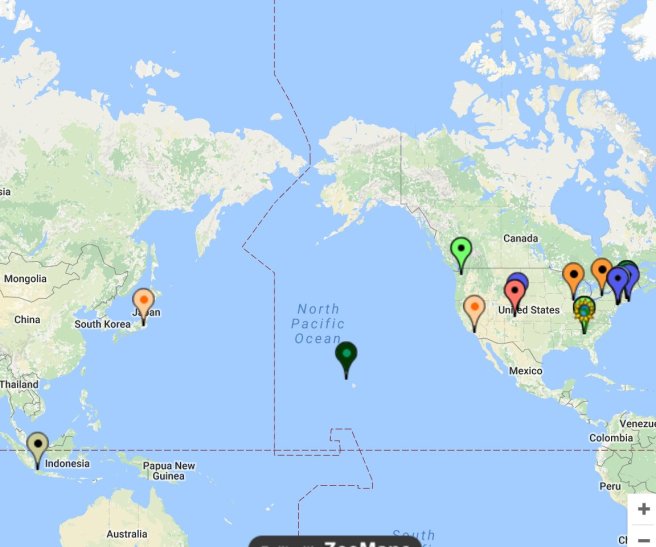
Starting on November 1, I’ll be running a leadership course with Reshan Richards (via the Global Online Academy). We’re expecting 21 educators from 18 schools and 6 countries.   Each night before my kids go to bed, we review the map to see if anyone else has added his/her location and bio. I’m feeling some parental urgency to show my kids that they can learn from, and with, people all over the world. I want this kind of learning to seem ordinary to them. For me, it’s still extra-ordinary.  Here’s the screenshot we grabbed tonight.

CwDOqEZWcAEsWN4.jpg

You Deserve to be Eaten by Amazon

By way of practicing what I preach I’ve recently been going through the “Things To Try” sections at the end of each chapter of Blending Leadership, picking out one or two of the activities, and trying them. Last week, I visited an actual shopping center staffed by real, live people.  I had the following “offline thing” in mind:

fullsizerender-2

I went to the mall because I had a free afternoon, and I had to buy some things for the start of the school year. I headed for a shoe store that carried my favorite shoe brand, the same shoe brand that I’ve purchased again and again over the years.

As I walked in to the store and started looking at some of the shoes, I noted that it was 5:01 p.m.  I was on a semi-scientific mission, after all, so I had to be precise. I kept looking at shoes, turning them over, roaming around the store, and nobody asked me if I needed help, nobody asked me to try on a pair of shoes, nobody even looked at me. At 5:08, still utterly unattended, I left, and for the first time in years, I considered a different brand of shoes. (Also, for the first time ever, I realized that my “relationship” with this particular brand was completely one-sided. I knew them, followed them, kept an eye on the way they changed — but they didn’t know a thing about me or how best to serve me.)

This cycle — of me being basically ignored as I tried to shop — repeated itself, to varying degrees, in three other stores. I walked into stores and either couldn’t find anybody to help me or found people who seemed very uninterested in helping me. Honestly, I often felt like an intruder or that I was interrupting the salespeople when I tried to engage them. I’m not suggesting that these kinds of sales jobs are easy or exciting. They involve a lot of standing around, near constant interactions with semi-difficult people, and certainly it’s not everyone’s passion to sell the things they are asked to sell in the mall. I recognize all of that, but overall, I found that the actual experience of going to the mall dramatically reinforced my opinion that online shopping is the better way (for me) to buy the things I need. In fact, I actually purchased something from Amazon ON MY PHONE from the mall because I just couldn’t figure out how to find what I needed quickly.  It may be many years before I drag my body back to a mall.

Time for a reflective rant: if you operate a store that offers a face-to-face experience for customers, then that face-to-face experience should be a big part of the value proposition. You should present eager salespeople who are eager to help customers. And to make that happen, you should invest money in training those people and holding them accountable for that experience. Because, honestly, if you run an organization that puts salespeople face-to-face with customers and the experience is as bad as it was for me the last time I went to the mall, then you deserve to be eaten by Amazon. And if you’re a school and guilty of the same charge, you deserve to be eaten by Khan Academy (or some other online equivalent).

As mobile technology becomes ubiquitous and trusted, people themselves become more mobile. Most people that I know really like mobility — they like being able to control more of their time, they like being able to avoid frustration. And what’s more frustrating than having to operate in poorly designed spaces (like parking lots or malls that are designed to keep you a little bit lost, a little bit disoriented, so that you spend more time in them)?

This is why I’m very proud to work at the school that I work at. At Montclair Kimberley Academy, we are investing time and energy and resources in building out and articulating social-emotional learning competencies to show students how to engage with each other and with the world. Even better, when we were getting ready to roll out these competencies, teachers and school leaders argued that the competencies should outline aspirational behavior not only for students, but also for adults — for the entire community. They said, “We, too, need to be civil to each other, we, too, need to be good to each other, we, too, need to be good listeners, we, too, need to model social and emotional competencies.”

I’m proud that I work in a school whose value preposition is, in some senses, blindingly obvious and yet hiding in that same obviousness. We plan to maintain and continually enliven the conditions for teachers to work face-to-face with students. It sounds almost goofy to say that so plainly, but it’s true. Working with students face-to-face, in school buildings, is something we plan, intentionally, to be exceptionally good at. So we’re always working at it, training around it, talking with kids about it, and doing it better and better every year. Sure, we’re an award winning 1:1 school with a reputation for innovative curriculum and program. Sure, we offer plenty of our instruction and learning resources via Moodle and Google Apps for Education. But we also get right the most basic and cherished part of the educational equation: teachers and students meeting together, face-to-face, to talk and think and question and grow and (someday, when the time is right) change the world.  Though I won’t go back, I’m glad I went to the mall. It provided a stark reminder of what I never want my school to be.