What’s Your School’s Thesis?

Today on his blog, Fred Wilson defined a venture capital firm as follows:

A venture capital firm, at least our venture capital firm, is at its core, a group of like-minded investors who come together around a shared investment thesis to work collaboratively to help entrepreneurs build companies.

When I was reading the definition, I found myself replacing certain words to see if the definition would apply equally well to schools.

A school is, at its core, a group of like-minded educators who come together around a shared educational thesis to work collaboratively to help students build skills and knowledge.

I think this definition does apply to schools — but only those schools that have really done a lot of work to articulate their educational thesis.  So maybe it doesn’t apply to that many schools after all.
OESIS, Pt. 1

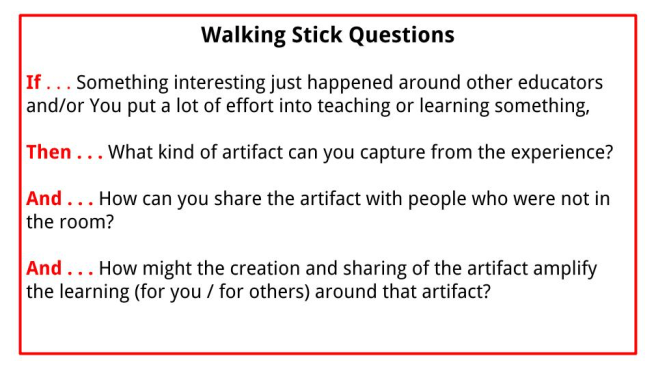
I’m about to jump on a plane home from the OESIS Boston conference.  I liked this conference a lot (and will explain more about that impression later this week).  For now, I want to share one artifact from a talk I gave about my creative and collaborative process:

WalkingStick?s.png

A Cubs Fan

Seeing actor Bill Murray in the stands at a Cubs game (on television, not in person, unfortunately), I was reminded of an article I read about him a while ago.  In particular, I was reminded of this quotation:

The more relaxed you are, the better you are at everything: the better you are with your loved ones, the better you are with your enemies, the better you are at your job, the better you are with yourself.

Interestingly, I also have a note that he said something similar in a lecture he gave at the minor league baseball Hall of Fame:

If you can stay light, and stay loose, and stay relaxed, you can play at the very highest level—as a baseball player or a human being.

One of these days, I’m going to relax enough to figure out why these quotes are always bouncing around in the back of my mind.

Guest Post, Sort Of

When I was just about to open Word Press and file today’s blog post, one of my advisees sent me a short email thanking me for a meeting we had today and including two paragraphs from a Jeff Bezos shareholder letter.  The Bezos quote is worth sharing (see below).  And it’s also worth marveling a little at the senior in high school who would first dig up the quote and then attach it to a thank you note.  I have the best job in the world.

Resist Proxies

As companies get larger and more complex, there’s a tendency to manage to proxies. This comes in many shapes and sizes, and it’s dangerous, subtle, and very Day 2.

A common example is process as proxy. Good process serves you so you can serve customers. But if you’re not watchful, the process can become the thing. This can happen very easily in large organizations. The process becomes the proxy for the result you want. You stop looking at outcomes and just make sure you’re doing the process right. Gulp. It’s not that rare to hear a junior leader defend a bad outcome with something like, “Well, we followed the process.” A more experienced leader will use it as an opportunity to investigate and improve the process. The process is not the thing. It’s always worth asking, do we own the process or does the process own us? In a Day 2 company, you might find it’s the second.”

~Jeff Bezos, 2016 Letter to Shareholders

https://www.amazon.com/p/feature/z6o9g6sysxur57t

Carrying a Spark

Today was one giant meeting stack.  I had an hour at the start of the day for “Feedback and Planning” (yes, I’m still sticking to this goal) and then I met with a leadership team followed by our Assistant Headmaster for Curriculum and Professional Development, our Professional Development Coordinator, and a group that is working as a kind of skunk works for curricular innovation.  In between, I also met with a few students.

I sat down tonight with the intention of seeing if I could pull a common thread from all these different meetings, and I’m happy to report that I found one.  In each of these meetings, at one time or another, at least one person in the room was working skillfully and effortfully to keep a spark, emanating from a student, alive.

In short, at least one person in the room had seen something in a student, a light of sorts, and wanted to make sure that it continued, that the light didn’t go out due to the exigencies of school, life, and world.

When I think of a great educator now, a new picture is forming.  I see a person walking through a windy stretch of land with his/her palms cupped together, and inside, a tiny spark.  He/she is carrying the spark from one point to another, not quite sure where the journey will end but quietly intent on making sure the spark is burning a little bit brighter when the handoff happens.

Working Definition

Prepping for a keynote presentation, I decided to try to really refine my definition of “thought leadership.”  This term is often derided — for good reasons — but I see it as a central component of leading in a world marked by mobility (you don’t have to work where you live), networks (you’re changed by connection, whether you like it or not), and near constant change and upheaval (too many examples to mention).  So here’s my latest working definition:

Thought leadership is a practice wherein you create a consistent, public (greater than 1) breadcrumb trail of inquiry, discovery, enthusiasm, generosity, and gratitude.  In a world that is as networked — and changes as constantly — as ours, leaders are those people who can lead by learning and learn by leading.  Thought leadership is a need-to-have, not a nice-to-have, an essential component of leadership, not a side effect, alternate route, or escape plan.  Done well, thought leadership doesn’t lead you away from your work, but deeper into it, drawing others closer to it as well.  It amplifies, connects, accelerates, and prods, flooding existing systems with new ideas. 

Email

We all know that email is a burden for everyone.  One of its best features — enabling asynchronous communication — is also its chief bug, i.e., whenever you’re not using email, someone is leaving you work to do in your inbox.  Take a break and you fall behind; fall behind and you can’t take breaks.

But last night, I made a decision to clear out some space in my calendar, stay up a little bit later than usual, and really work hard in my inbox.  I communicated as clearly, directly, and energetically as I could.  I picked up old threads.  I started some new conversations.  I invited some people into, or back into, my workflow.  I sent out thank yous and provocations and improvisations.  I closed some loops that desperately needed closing and opened a few that needed opening.  In short, I tried to make email feel artful and personal again.  Vital again.

And today, as people responded to last night’s flood of emails, I felt truly energized every time I looked at my inbox.  The energy, inquisitiveness, and creativity of the emails I received matched the energy, inquisitiveness, and creativity of the emails I had sent.  Being in email felt like being in really good conversations.  It felt human.  The game itself didn’t change, but for an evening and a day, the players did.