
Reshan and I put some thoughts together, in partnership with Global Online Academy, to help school leaders prepare for the possible shift to online schooling. Please share widely.

Reshan and I put some thoughts together, in partnership with Global Online Academy, to help school leaders prepare for the possible shift to online schooling. Please share widely.
Leaders can explain or they can embody.
Say, for example, they lead curriculum and instruction in a high school and believe that online learning is important for students to experience at least a few times before they go to college. An explainer would make the case, would present the evidence, might tell a story or two, and would try to influence teachers to engage students in online learning. An embodier, on the other hand and from time to time, would run meetings with those same teachers using online portals or tools. She would use the tools she wished to promote, allowing the experience of those tools to make the case for her.
An explainer leaves certain people behind — in the above case, those faculty members who do not listen or respond well to lectures or talking. An embodier leaves behind certain people, as well — in the above case, those faculty members who have difficulty learning from what they see and experience and then adapting it to their own circumstances.
As a leader, you have to decide how you want to teach. You have to decide which followers you want to lead. And of course it doesn’t hurt to vary your practice, to make things less black and white than I have made them.
“Leadership: A Fan’s Notes # 1” can be found here. I’ll aim to keep this series going if you like it — and probably even if you don’t. Shows you what kind of leadership I lean towards.
Here’s a story and meditation I wrote down several years ago. A colleague just mentioned it — the story, not my written version of it — so I decided to pull this out of the files and share it with you.
Picture this. It’s a beautiful fall afternoon. A gentle breeze shakes the gold-edged leaves of the trees just west of Lloyd Road and shoulder pads crash on the turf just east. Elvoid Christmas is at the front desk, talking to stragglers, students and faculty alike, as they head for home or stage, from field or classroom, carrying books and laptops and uniforms and costumes.
Now pan to the science wing where things are hushed. A teacher works in her classroom, preparing for an 8:00 a.m. lab. She is alone, making progress, but only briefly.
For out of the discrete silence of the science wing walks a large, brown spider. This spider is the kind that, we imagine, might not just bite us but that wants to bite us. The kind that would send most of us flailing out of the room in search of the nearest rolled up newspaper.
But this teacher just cocks her head to the side and smiles, because this is Dr. Carrie Fyler, a scientist who has spent countless hours in science labs, has done meticulous research on tapeworms and seals and has turned such encounters into peer reviewed papers. Warm-hearted and curious, she takes the world as it comes.
So Dr. Fyler doesn’t scream or instinctively smash the spider with the nearby safety goggles. Instead, she gently covers it with the nearest petri dish. Something from the natural world has lit up Dr. Fyler’s imagination. She has thought of something.
Seconds later, the email inboxes of Dr. Fyler’s colleagues in the science department begin to light up, too. Dr. Fyler has written a polite inquiry: “If nobody has any use for the spider I just found, I’d like to amplify and sequence its DNA with one of my classes.”
And so the spider sits in a jar, since joined by two others, waiting to become part of the science curriculum. Using field guides, Dr. Fyler will lead her students through a primary identification. Then, using our lab technology, she will teach the students how to amplify a gene and how to then send that gene to another lab that can sequence the DNA, to aid in further exploration.
Dr. Fyler’s spider is worth pondering, but so is the story about Dr. Fyler and the spider. It asks just a little for us to see it unfold, but it asks a lot, too, in that it’s an invitation to reconsider and renegotiate the lines that we sometimes draw around learning.
First, the story teaches us that the “classroom” is not always located at the physical addresses of our schools. Sure, students and teachers meet in schools, and they spend much of their time together in classrooms, but the site of learning can and does shift. Sometimes learning unfolds when we focus on textbooks. Sometimes it unfolds when we focus on what’s happening in a test tube or on a board or in a discussion. And sometimes it happens when we focus on something that walks into our lives on eight legs.
Second, Dr. Fyler could consider the power of amplifying a spider’s gene because she was an educator who understood that the well-timed improvisation might lead to an intensification of standard knowledge and conventional understanding. Students must do their best to attach new knowledge to old. Teachers must be prepared to push their lessons into authentic contexts and experiences – into the unexpected and new.
I set up a repeating event in my calendar — Wednesday, 7 a.m. — that prompts me to choose a tool from Project Zero’s Thinking Routines stack*.
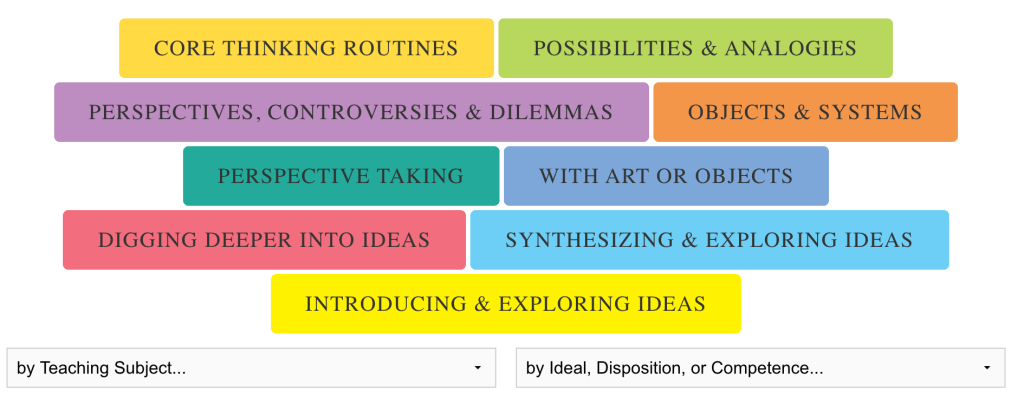
I quickly click a box and select a tool. Lack of forethought and purpose is part of the fun for me. Picking a tool is like picking an Oblique Strategy . . . and in the same way, I allow the tool to create a ripple in my day, using it, where possible, in the class I teach or in the meetings I run. So far, so good.
Today, for example, I used this slide in my English class.

I asked my students to share what they wrote, and many of them developed a similar idea: “I originally thought that comic books or graphic novels were just for fun or funny thoughts, but I now think that this type of storytelling is not only useful for telling serious stories but may be preferable.” Just like that, a whole class of teenagers acknowledged that they had changed their mind about something and solidified a new layer of understanding about the role of storytelling in their lives.
*H/T to Eric Hudson for tweeting about these routines and bringing them to my attention. To know him is to learn from him.

Source: Avalanche Magazine w/ HT to @mattdesl
Searching for something else, I found this reference to a Gallup Organization study of four hundred organizations and a cross section of eighty thousand great and average managers.*
Exceptional managers create workplaces in which employees emphatically answer “yes” when asked the following questions:
Given that’s it’s February in my part of the world, and work can feel like a slog until the weather warms up for good, I’m happy to be reminded to check in, in very precise ways, with the people on my teams. Is work working for them?
*Source: Marcus Buckingham, First Break All the Rules
We’re “in-service” at school today . . .
This means that students are at home or traveling and teachers are spending time on a variety of activities mainly characterized as getting things done or thinking about, interrogating even, how we get things done.
We started the day “talking shop” in teams. All teachers in the school had previously observed a colleague, been observed by a colleague, or recorded themselves teaching and then watched the recording. The discussion was meant to serve as a debrief — what did you learn? — and a spur to share ideas and solutions.
We used these questions to jumpstart the discussions (though these particular discussions never require much prompting)…
My personal takeaways — things I will act on immediately — from the group conversation were as follows:
For school people, the above template should be easy to follow and (if you wish) apply. I know that some readers of this blog do not work in schools, however. I’m still hopeful that the process and outcomes described above may be useful to you. What opportunities exist for you to observe others or be observed? What aspects of your job are even observable? Would it be possible or useful to occasionally begin your workday by talking shop, by thinking about, interrogating even, how you get things done?
This quote comes from an interview with/of Noah Brier, co-parent of the always interesting Why is this Interesting? newsletter:
Culture is this level of a company that allows you to not have a process for things.
Source
I like that the statement feels tossed off and casual. It’s not claiming full truth or authority, and I think that’s a smart posture for wisdom. It feels approximately true, so it makes me want to turn it over, test it, see how closely it aligns to my current state. I wonder:
Is the statement useful, or could it be?
(I think so, so I’ll keep asking questions.)
What’s the process for creating a process in my organization?
Is process born and implemented on purpose . . . as a form of quality control, as a form of control control, as a response to a quirk of someone’s personality (Billy likes processes so we have a lot of them), or as a retroactive response, because a certain mess keeps happening?
Or is process implemented by accident?
Strategically?
Or, maybe worse, is it implemented as intentional/strategic approach to some things and not others? Who gets to decide?
The last part — processes’ potential randomness — is most interesting to me. It makes me want to slow down before creating formal processes in my organization, asking — as spanner — does this need a process or will our culture take care of it? Could, in fact, our culture be harmed if we turn this or that (or everything) into a defined process, if, in fact, we don’t exercise it every so often.
I think Brier is talking, sidelong, about trust. And that’s an institutional muscle you want to use. Or lose.
The best leaders do hard work that grows them. They both seek out such work — by identifying problem areas that could use some attention and effort — and engage with such work due to their habit of taking full responsibility when necessary.
Full responsibility is defined as that moment when leaders stop pretending or imagining (or even just hoping) that someone else will handle a project / problem / pothole / possibility. They sit down and do the work. They write the memo. They create a draft or a set of slides. Or they show up in person and have the conversation. Or they make the decision and share it. Or they communicate honestly and clearly and authentically. They stop waiting for the right energy or capacity or skill or superhero; instead, they marshal all of their existing resources, whatever they’ve built and saved and stored, and put them to work. It helps that they also have the belief that this effort will be good enough.
Over time, working on hard things and taking responsibility helps leaders to develop a sense of calm competence derived from an “I’ve seen this before and I know what this is” leadership rolodex. This doesn’t mean they are not surprised from time to time; this doesn’t mean they do not encounter new, unidentified, formless, first-time-in-a-career problems. It’s just that they know how to approach most problems and issues because they’ve seen them before . . . and by extension, they know to slow down and take their time with problems and issues that defy their existing categories. It helps that they also have the belief that new problems, meticulously solved, will ultimately find their way into categories, too.
Brian Doyle, a writer’s writer and purveyor of hard earned, deeply studied joy, died recently. While living, he was often taken to task for stretching the bounds of grammar. Below I’ve copied James M. Chesbro’s defense of Doyle’s (de)compositions. It’s pulled from an obituary, but the part I’m emphasizing is really more of a lesson for aspiring writers and readers (as Doyle would probably want it).
Some may find Doyle’s run-on sentences to be an irritation, but that’s also part of his genius. When we don’t land on the deep breath of a period and instead skip by on another comma, we are looking at a subject with Doyle’s sustained gaze, and eventually he takes us to a fresh metaphor, or an unexpected insight. [Source.]
The why is buried in the how. Confusion is a sign that a door is cracked open. When we don’t land as expected, we are looking elsewhere, unexpected. Reading a writer’s writer has its just rewards.
 Refreshing Wednesday, LLC