
I can write an expansive blog post, or I can pick up my son and hang out with him after a very packed week. Easiest choice of the week, month, and year.
Month: April 2019
Locked in meetings, and . . .
As the header says, I was literally locked in meetings today. 5.5 hours of them. This morning, before the day began, I looked at my calendar and thought to myself, “I’m not going to get anything done today” and “I’m not going to get better today.”
Then I had my coffee and started to feel more upbeat.
You can get plenty “done” in meetings, in that you can help the teams (around which the meetings are formed) advance their agendas. You just can’t always advance projects for which you are an “individual contributor.” Which is all the more reason to make sure you’re blocking time for that work.
Also, you can “get better” in meetings because meetings allow you to practice certain skills and dispositions.
- You can practice listening.
- You can practice checking for understanding. For example, you can ask, “did I hear you correctly?” or say, “let me repeat that back to you to make sure I understand.”
- You can practice asking questions.
- You can practice synthesis and meaning-making. Both can be done in person, during the meeting, or via the notes that you write during the meeting and possibly distribute after the meeting.
- You can practice sketchnoting (and should if, like me, you tend to only take notes using words).
- You can practice restraint — a muscle that, in my experience, grows stronger each time you use it.
- You can practice not talking unless you have something to offer that is both relevant and not being said.
- You can bring a cup of coffee to someone who is struggling or in need of a boost.
- You can give someone’s idea a really good workout, i.e., you can work hard for a colleague.
- You can practice shining a light on the work of others instead of seeking such light for your own work.
- You can practice caring for others (by bringing food or volunteering to help set up or break down the room).
- You can practice connecting with others, especially others you don’t know or others you haven’t seen in a while — before or after the meeting.
- You can help others practice. One great move is to ask someone to rehearse something they are planning to say or do. To insist that they rehearse, in fact, even if they feel silly doing so in front of you, is a way to make your presence count for them.
- You can provide loving feedback, i.e., feedback that shows that you truly respect and value someone, delivered in a kind and compassionate way.
- You can practice contributing “at the right level.” It’s important to develop a sense for when a 50,000 foot ear is listening and when a ground-level ear is listening. Keep your boss out of the weeds when possible; keep your direct counterparts in the weeds when possible.
- You can practice disagreeing agreeably. Being a “yes” person isn’t helpful to your organization over the long run. But it’s easy to pump negativity fog and to become known for that. If you’re not careful, over time, honest, ambitious, idealistic, and innovative conversations will happen only outside of your earshot.
- You can stop saying “but” and try saying “and.”
I think, by now, you get the idea. Some meetings are great; some are not; and you can always make choices about your own progress through them.

Make Yourself Clear: Toolkit Tab

Reshan and I have been adding resources to the “Toolkit” section of the Make Yourself Clear website. Take a look.
Make Yourself Clear: Pro Tip
In a recent profile of Robert Caro, David Marchese asks Caro about his practice of planning his books.
I know that when you’re planning your books, you write a couple paragraphs for yourself that explain what the books are about, and then you use those paragraphs as a North Star to guide your writing and outlining.
This, and one additional question, leads Caro to demonstrate how the technique works in practice. How it helps him to tell the right stories and eliminate stories that, though they are interesting or compelling, don’t connect to his “North Star” paragraphs. How it serves as a kind of invisible fence around the province of his subject. Caro explains, vis-à-vis his magisterial Master of the Senate:
Here’s how I boiled that book down: I said that two things come together. It’s the South that raises Johnson to power in the Senate, and it’s the South that says, “You’re never going to pass a civil rights bill.” So to tell that story you have to show the power of the South and the horribleness of the South, and also how Johnson defeated the South. I said, “I can do all that through Richard Russell,” because he’s the Senate leader of the South, and he embodies this absolute, disgusting hatred of black people. I thought that if I could do Russell right, I wouldn’t have to stop the momentum of the book to give a whole lecture on the South and civil rights. What I’m trying to say is that if you can figure out what your book is about and boil it down into a couple of paragraphs, then all of a sudden a mass of other stuff is much simpler to fit into your longer outline.
nytimes.com/interactive/2019/04/01/magazine/robert-caro-working-memoir.html
Clarity is always about choices, or, as the old writer’s dictum goes, “having the guts to cut.” It helps one’s confidence in such cutting to boil things down, to trim along the edges of the shadow cast from a clear North Star.

Activating Prior Knowledge
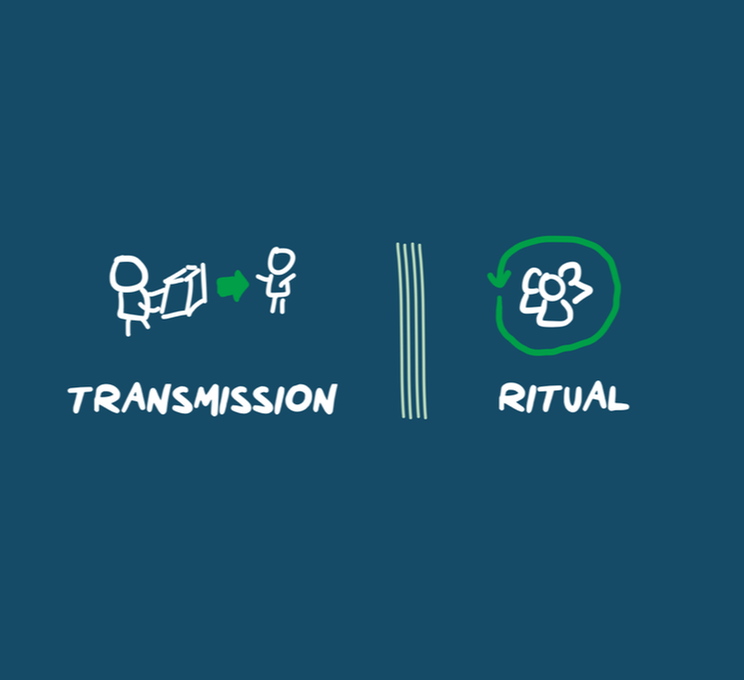
If you read this blog everyday, the following image (built by Reshan Richards) will push you to think back on an earlier post. As a teacher, in my classroom, I’m constantly concerned with finding tie-ins to former lessons, books, conversation . . . and this activity helps students to activate prior knowledge or build new knowledge.
Sometimes I forget that this blog is like a classroom, too. I should be using some of the same moves that I use in my classroom. But I didn’t forget today. If you’ve been reading faithfully, see if you can recall the post to which the image refers. And if you’re new to the blog today, or haven’t read it in a while, go digging in the recent archives. See what kinds of connections you can make.
 Refreshing Wednesday, LLC